Subledger: Subscription Log
Tudo o que renova, sem conectar ao seu banco.
- IOS
- ANDROID
- Utilidade
- Disponível


Sobre o Subledger
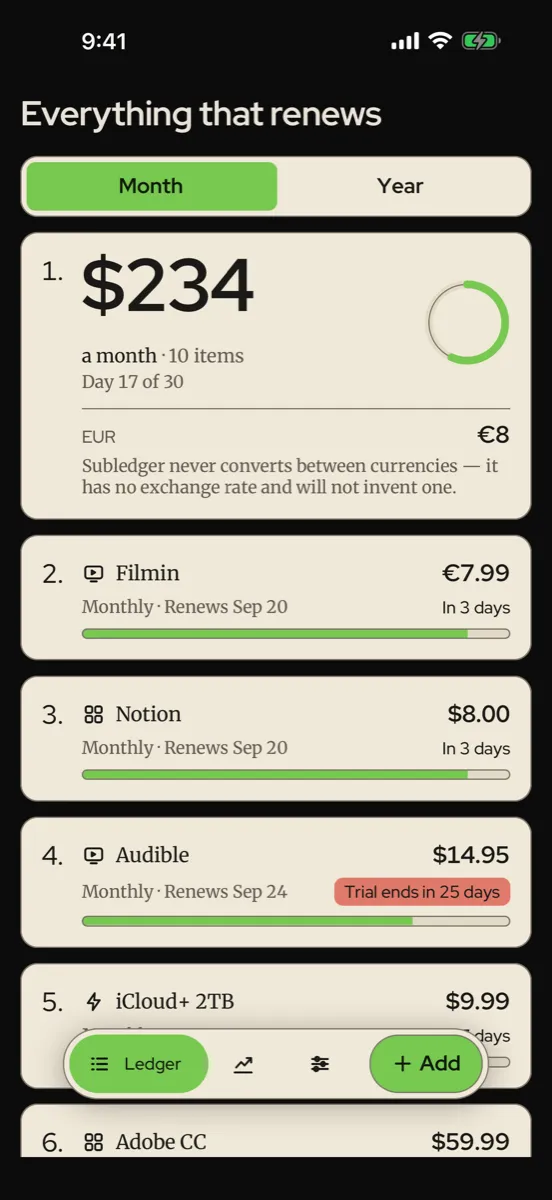
Um controle manual de tudo o que renova: assinaturas, seguros, domínios, associações, garantias. O app nunca se conecta a um banco — você digita o que paga e ele transforma um monte de valores mensais e trimestrais em um único número anual honesto, calculado por moeda e nunca somado entre moedas. Avisos de fim de teste alertam antes de uma avaliação gratuita começar a cobrar. As datas de cobrança usam aritmética de calendário que nenhum horário de verão desloca, e tudo fica no seu aparelho.
Recursos
Nenhuma conexão com o banco, nunca
Você digita cada item. Não há conta, nem login, nem servidor nosso, nem acesso somente leitura a nenhuma instituição — o app não tem para onde mandar sua lista nem se quisesse, e é por isso que a promessa pode ser verificada em vez de apenas afirmada
Avisos de fim de teste
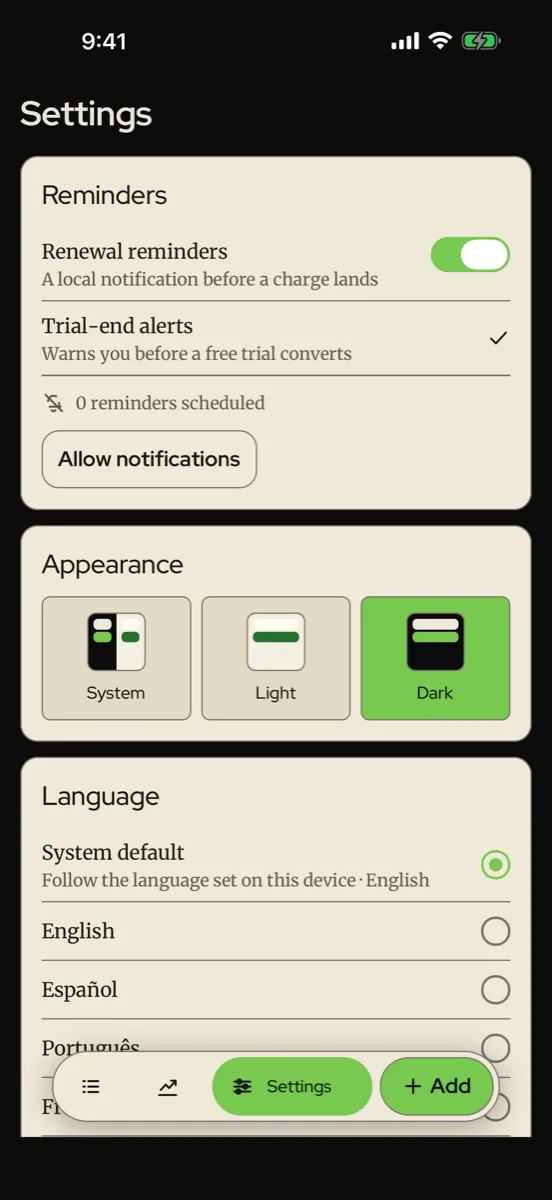
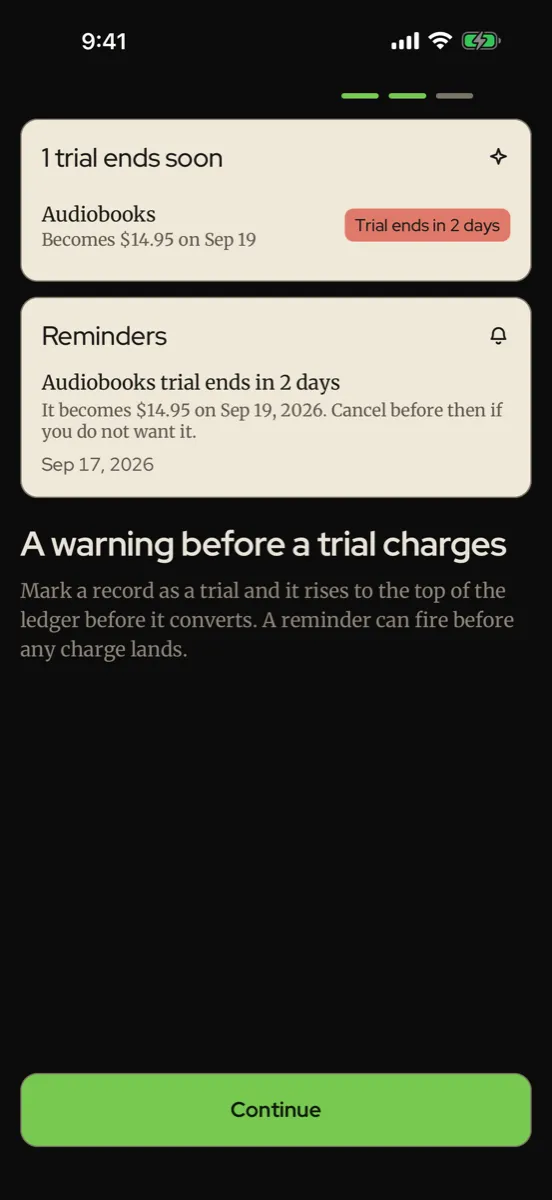
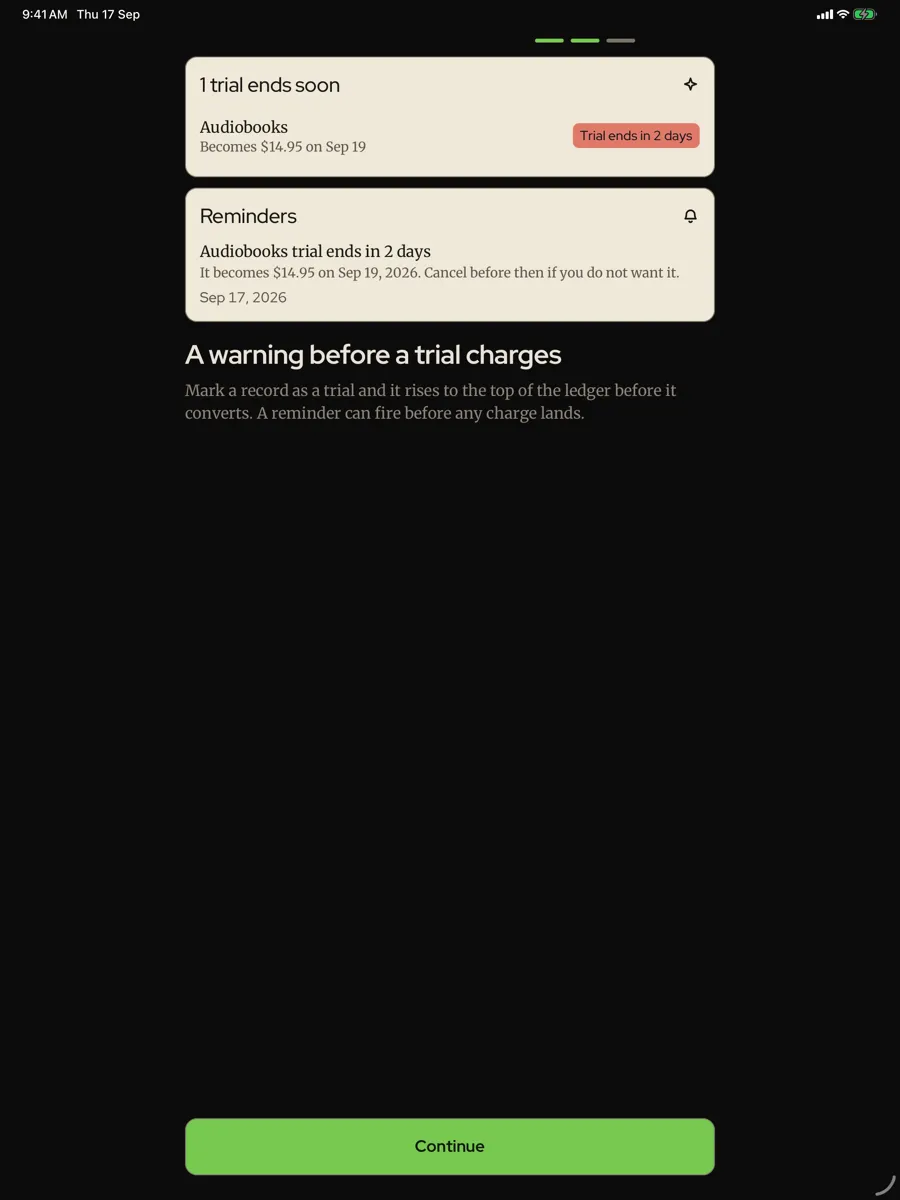
Marque um registro como teste com data de término e o app o destaca na tela inicial e agenda uma notificação local com dois dias de antecedência, por padrão — não um, porque um teste que vira cobrança amanhã pode já ter passado do prazo de cancelamento do próprio fornecedor
O número anual honesto
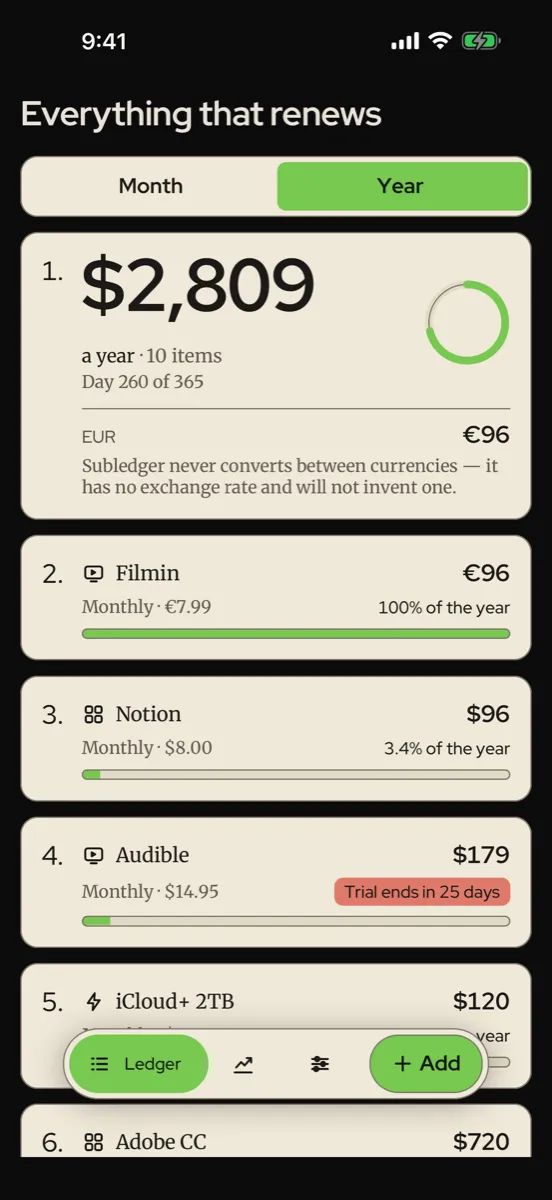
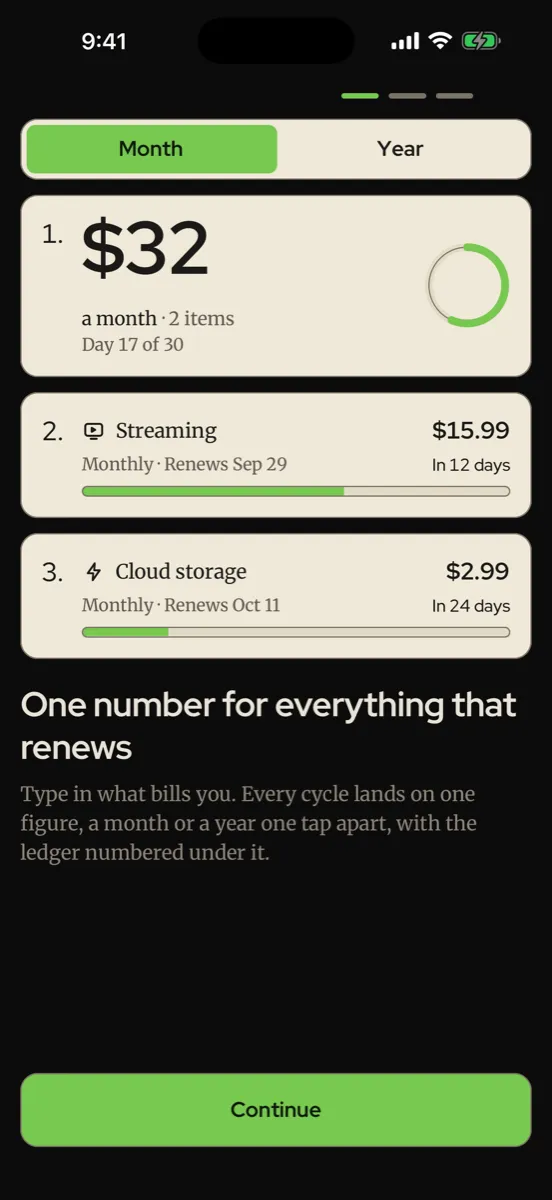
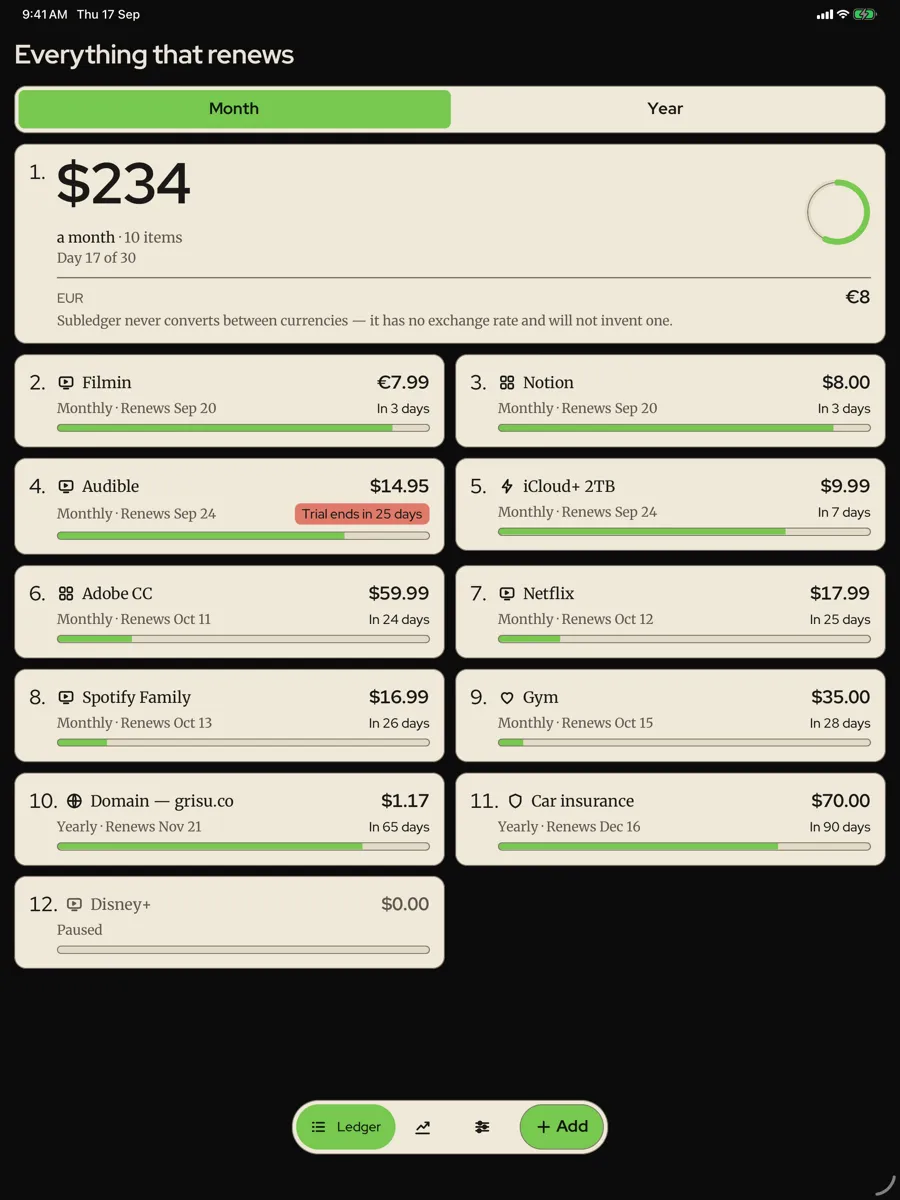
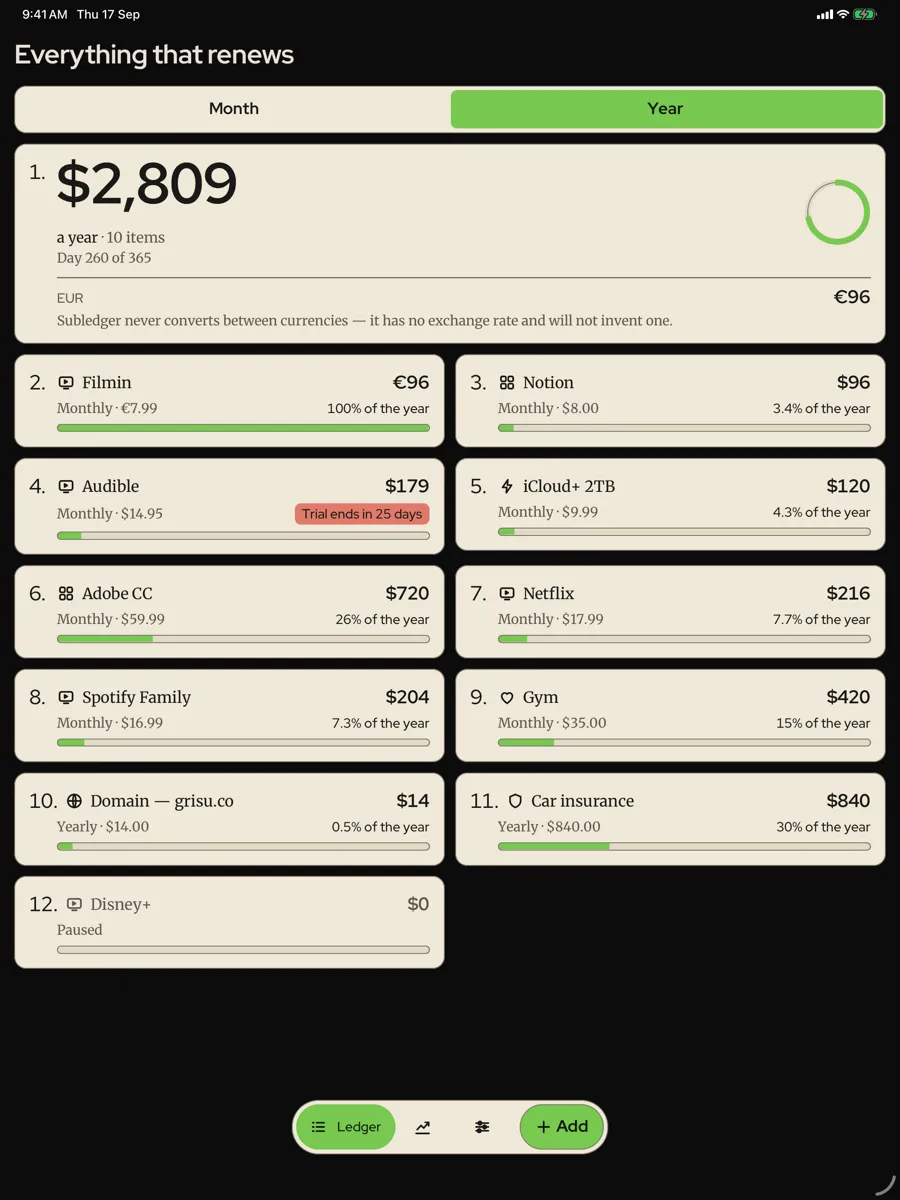
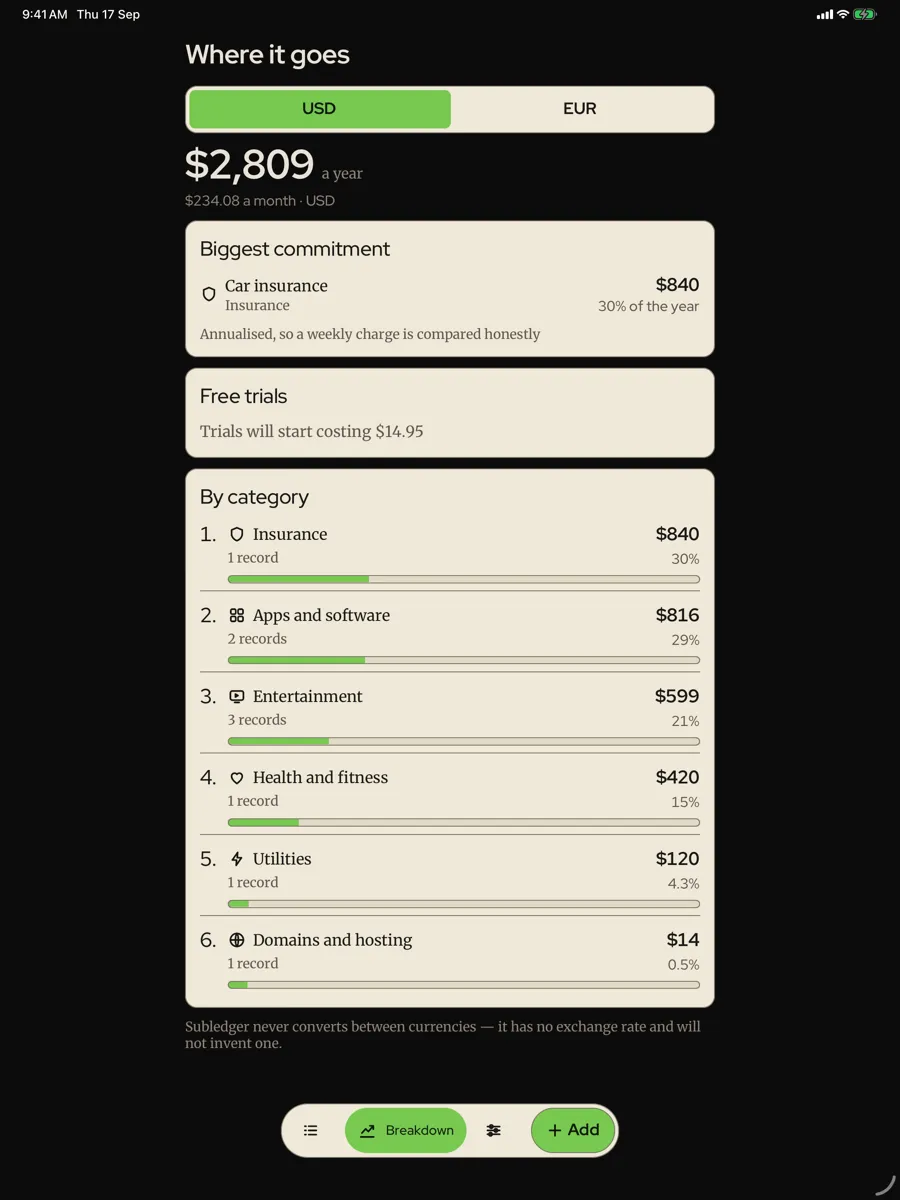
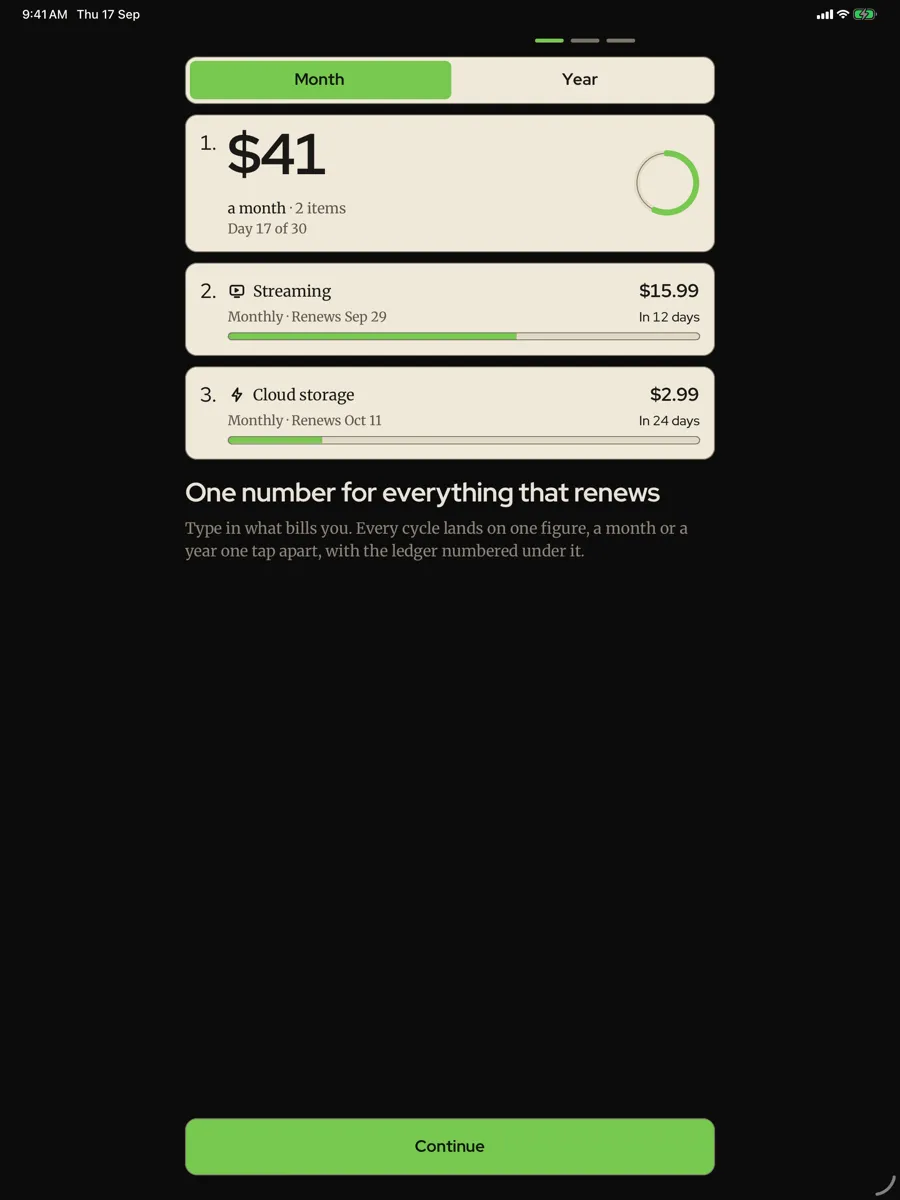
Cada ciclo é convertido em um valor por ano, com cobranças semanais anualizadas a 365,25/7 em vez do confortável 52. Ele é mostrado por moeda e nunca somado entre moedas: não há taxa de câmbio offline, e um total errado sem aviso é pior do que nenhum total
Datas de cobrança que não escorregam
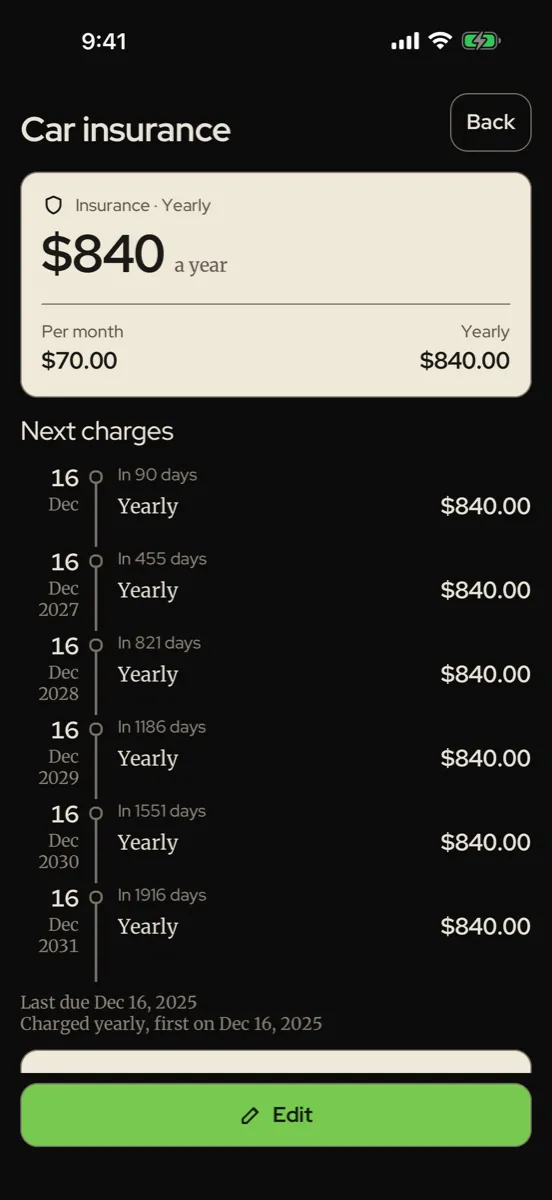
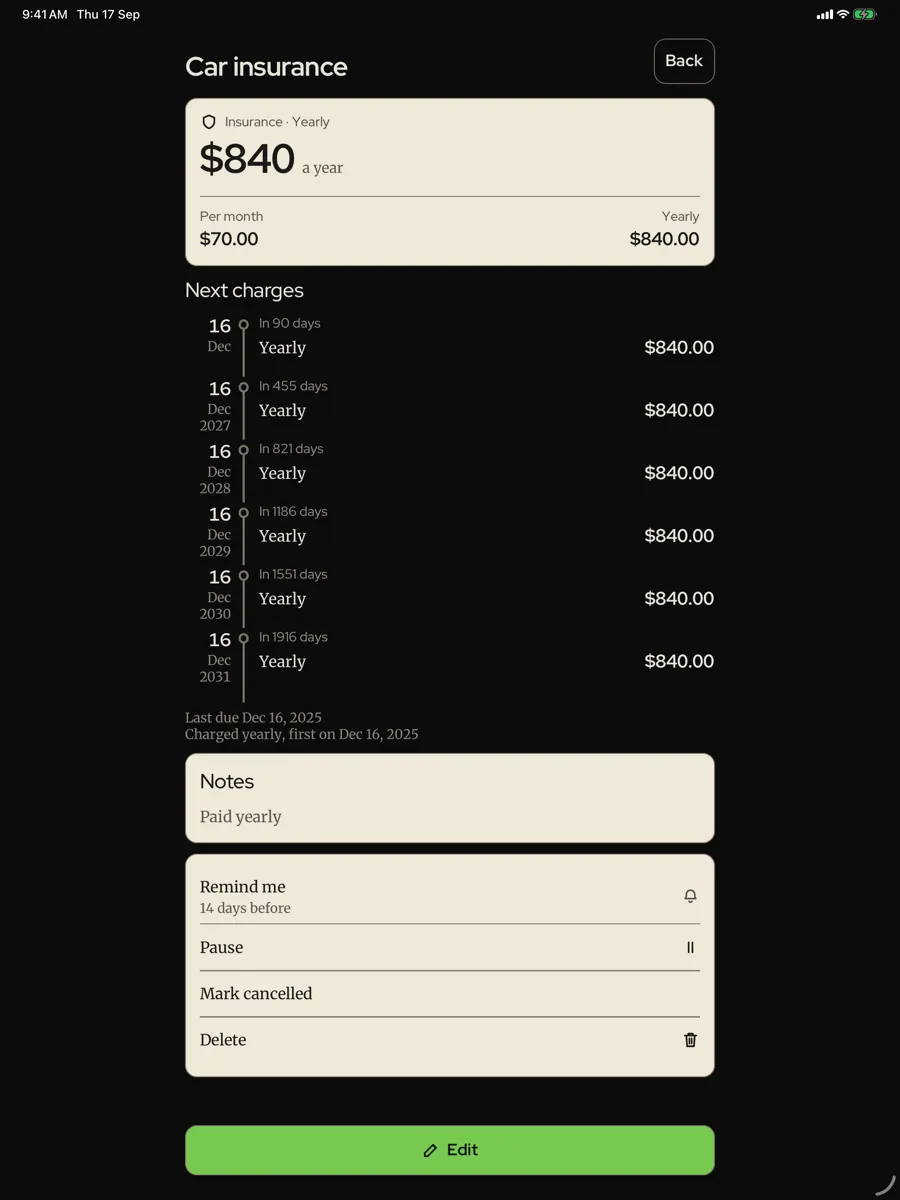
As ocorrências são contadas a partir da primeira data de cobrança, em vez de encadeadas a partir da última, então uma conta mensal cobrada pela primeira vez no dia 31 dá 28 de fevereiro e depois 31 de março — e não 28 de março para sempre. A aritmética usa dias do calendário civil, então nenhuma mudança de horário de verão consegue mover um dia de cobrança
Linha do tempo de 30 dias e divisão por categoria
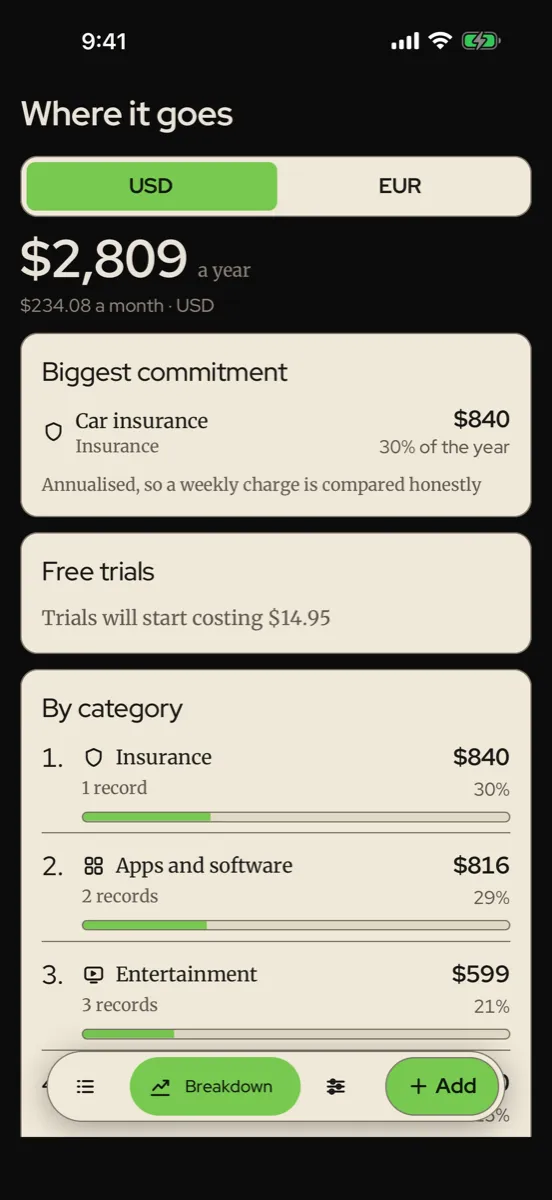
A tela inicial mostra o valor anual e depois uma linha do tempo com datas do que realmente vence nos próximos trinta dias. A tela de divisão reparte seu compromisso em onze categorias — entretenimento, software, seguros, domínios, garantias e as demais — também por moeda
Um pagamento, não uma assinatura
Cinco itens são grátis para sempre, incluindo o valor anual, a linha do tempo e os lembretes de renovação. com.grisu.recur.pro é uma compra única que libera itens ilimitados, avisos de fim de teste, a divisão por categoria e a exportação em CSV — um controle de assinaturas que cobrasse assinatura seria uma piada às suas custas
Capturas de tela
O texto detalhado abaixo ainda não foi traduzido e é exibido em inglês.
About Subledger
You already know roughly what you pay every month. Subledger exists to replace roughly with a number — and to do it without ever asking for a bank login.
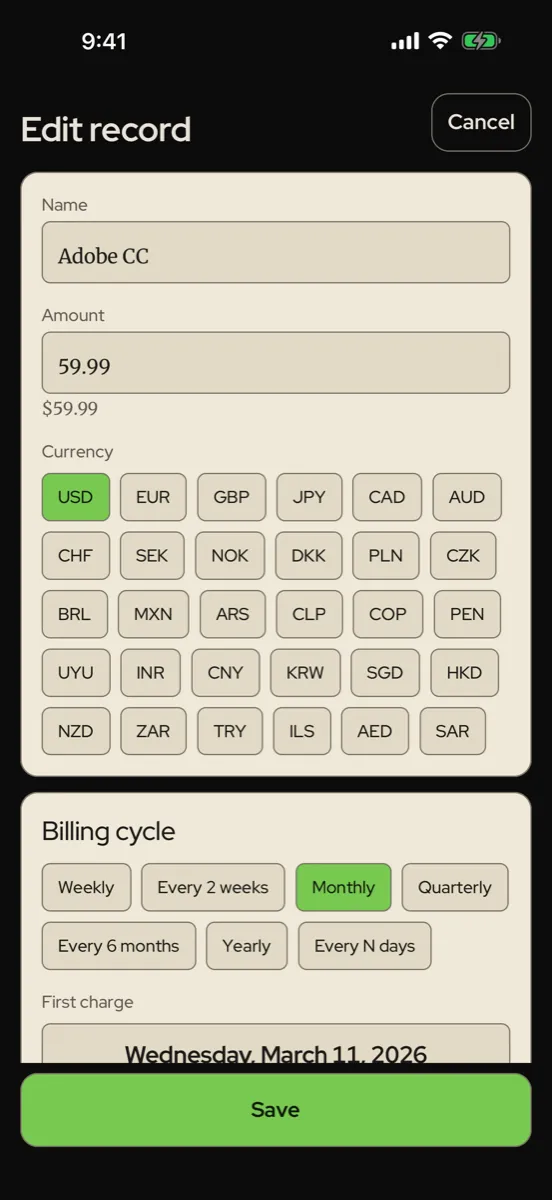
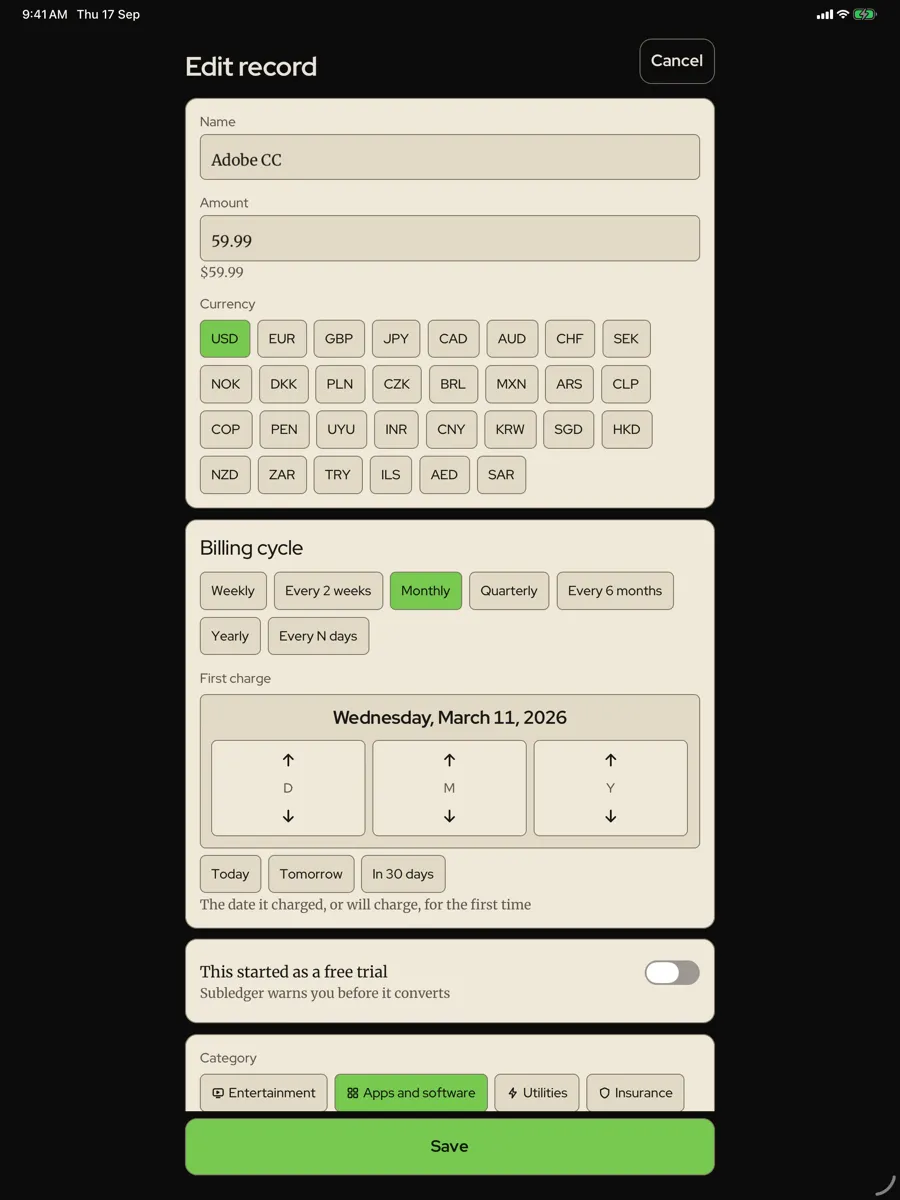
You type each item in: name, amount, currency, cycle, the date it first charged. In return the app gives you the figure that pile of small charges actually adds up to over a year, a dated timeline of what is due in the next thirty days, and a warning before a free trial turns into a charge. Subscriptions, insurance premiums, domain renewals, gym memberships, extended warranties — anything with a next date and a cycle belongs here.
Why it will never connect to your bank
The obvious way to build this app is to read your transactions. The best-known product in the category does exactly that, and charges a monthly fee for the privilege of watching your money move.
Subledger takes the opposite trade deliberately. Typing in a dozen items costs you ten minutes once; handing a third party a live feed of every purchase you make costs you something you cannot get back. So there is no aggregator, no OAuth screen, no read-only credential, no account and no server of ours. Your list lives in a SQLite database inside the app’s private storage, and the only thing that ever leaves the device is a CSV file you explicitly asked to export and then chose where to send.
That is not a feature we can quietly drop in a later version. There is nothing to switch on: the app was written without the network path in the first place.
The number, and why it refuses to lie to you
A list of “$4.99 a month”, “£12 a quarter” and “€89 a year” is not readable as a commitment. Normalising all of it to one per-year figure is the single transformation that makes the total something you can react to, and it is the largest thing on the home screen.
Two decisions keep that number honest. Weekly charges are annualised at 365.25 ÷ 7, not 52 — a weekly bill charges 52.18 times a year, and the comfortable answer under-reports exactly the cycles people already underestimate. And nothing is ever summed across currencies. The app has no exchange rate, because it has no network to get one from, and a rate baked in at build time would be wrong within a week. So dollars, euros and pounds are reported side by side, per currency, and the code will throw rather than produce a plausible-looking total that mixes them.
Dates computed the boring way
The arithmetic underneath uses no timestamp at all. A billing date here is a civil calendar date — a year, a month and a day, with no time and no zone — and every calculation is exact integer maths over a day count. A daylight-saving transition has nothing to shift.
Occurrences are also indexed from the anchor rather than chained from the previous one, which is what stops the classic drift: a monthly bill first charged on 31 January falls on 28 February and then back on 31 March, instead of quietly moving to the 28th for the rest of its life. The same logic drives the timeline, the annualised cost and the reminder schedule.
Currency symbols, decimal places and date formats come from your device rather than from a hardcoded assumption, so an amount typed as 1.234,56 and one typed as 1,234.56 reach the same number.
What it costs
Five tracked items are free, permanently — enough to see the number the app exists to show. One payment unlocks unlimited items, the trial-end alerts, the category breakdown and CSV export. Not a subscription: for this app in particular, that matters.
The free tier carries ads from Google AdMob, which is the one thing that sends anything off your device. What that involves is set out plainly in the privacy policy.


Mais apps como Subledger
-

Aubade: Daily Affirmations
Uma frase por dia, no papel e na sua tela de início.
-

Valise: Trip Planner & Split
O plano, o mapa e o dinheiro de uma viagem, numa mala no seu celular.
-

Quadrille: QR Scanner & Maker
Códigos QR como objetos de design: estilize, escaneie, guarde.
-

Paid in Full: Debt Free Date
Veja sua data sem dívidas, quanto custam os juros e tarifas, e acompanhe cada pagamento.