Subledger: Subscription Log
Todo lo que se renueva, sin conectar con tu banco.
- IOS
- ANDROID
- Utilidad
- Disponible


Sobre Subledger
Un registro manual de todo lo que se renueva: suscripciones, seguros, dominios, membresías, garantías. Nunca se conecta a un banco: tú escribes lo que pagas y la app convierte un montón de cargos mensuales y trimestrales en una única cifra anual honesta, calculada por moneda y nunca sumada entre monedas. Los avisos de fin de prueba te advierten antes de que una prueba gratuita empiece a cobrar. Las fechas de cargo se calculan con aritmética de calendario que ningún cambio de hora puede mover, y todo se queda en tu dispositivo.
Características
Nunca se conecta a tu banco
Tú escribes cada elemento. No hay cuenta, ni inicio de sesión, ni servidor nuestro, ni acceso de solo lectura a ninguna entidad: la app no tiene adónde enviar tu lista aunque quisiera, y por eso la promesa se puede comprobar en lugar de solo afirmarse
Avisos de fin de prueba
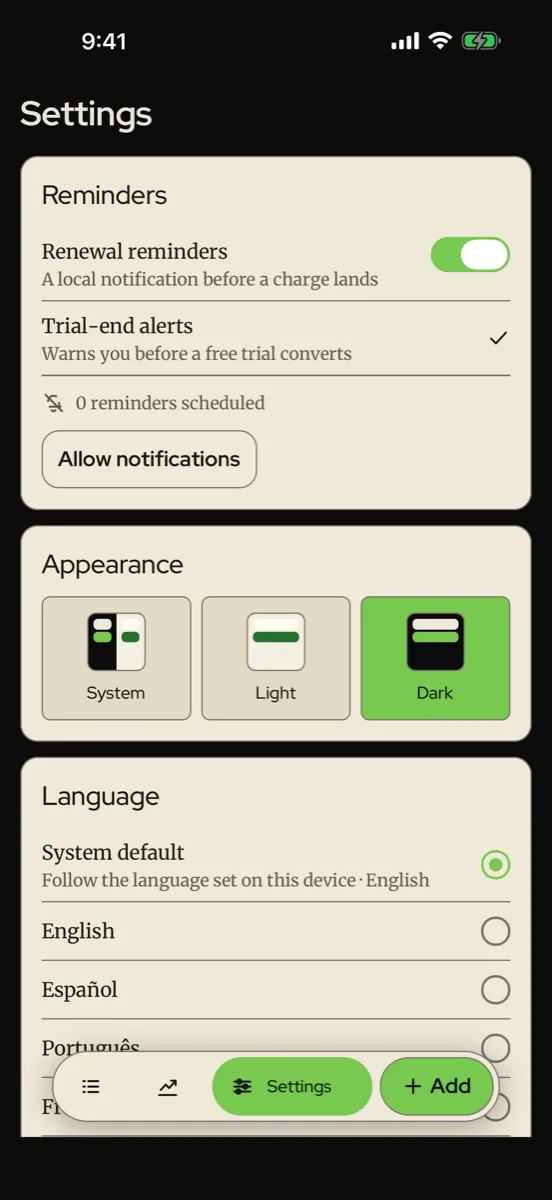
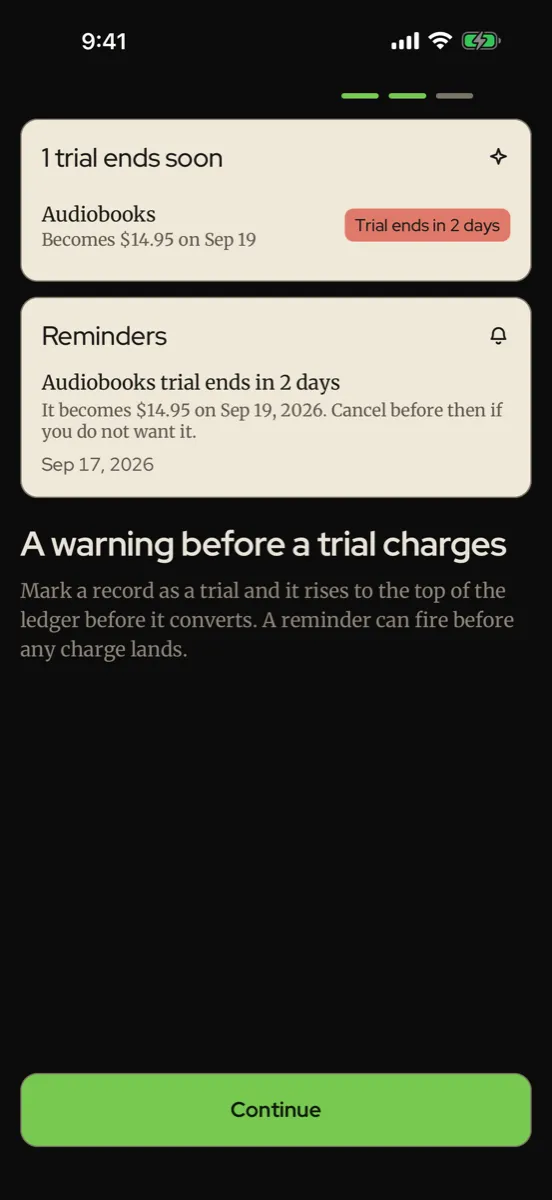
Marca un registro como prueba con fecha de fin y la app lo destaca en la pantalla de inicio y programa una notificación local con dos días de antelación por defecto; no uno, porque una prueba que empieza a cobrar mañana puede haber pasado ya el plazo de cancelación del propio proveedor
La cifra anual honesta
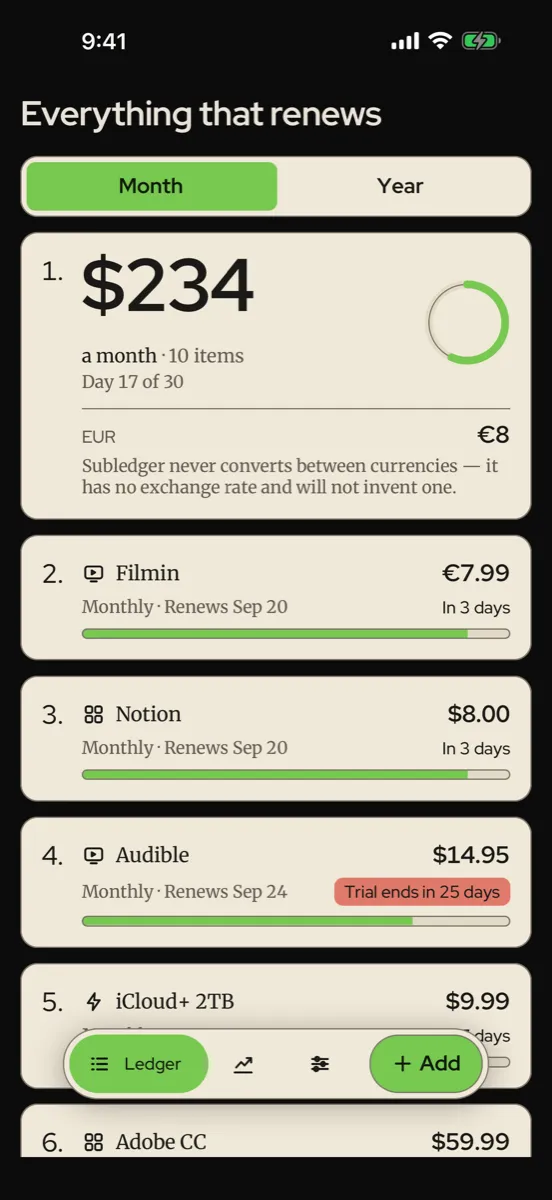
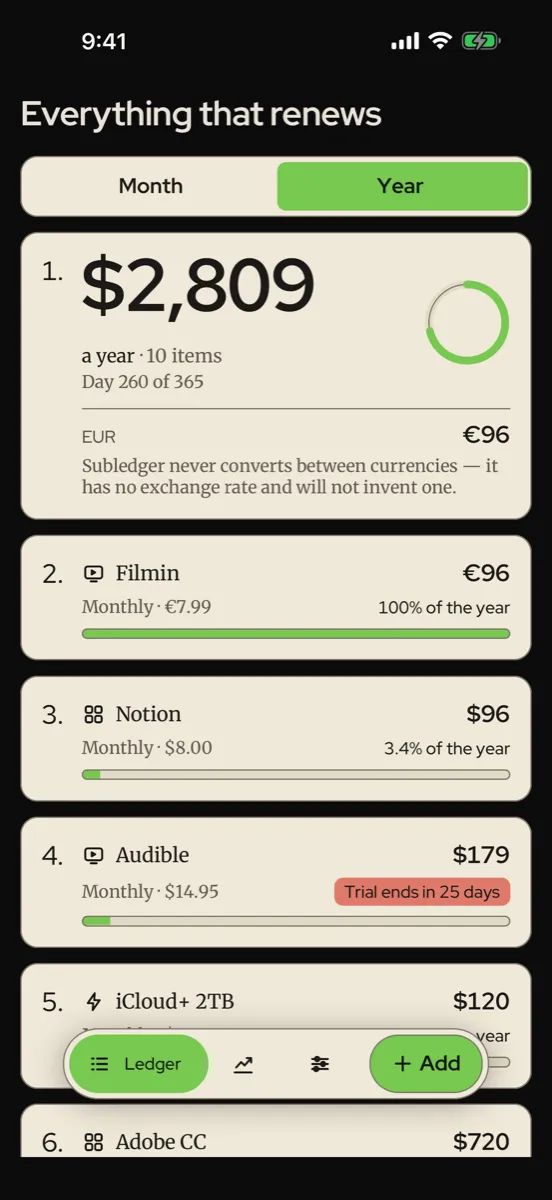
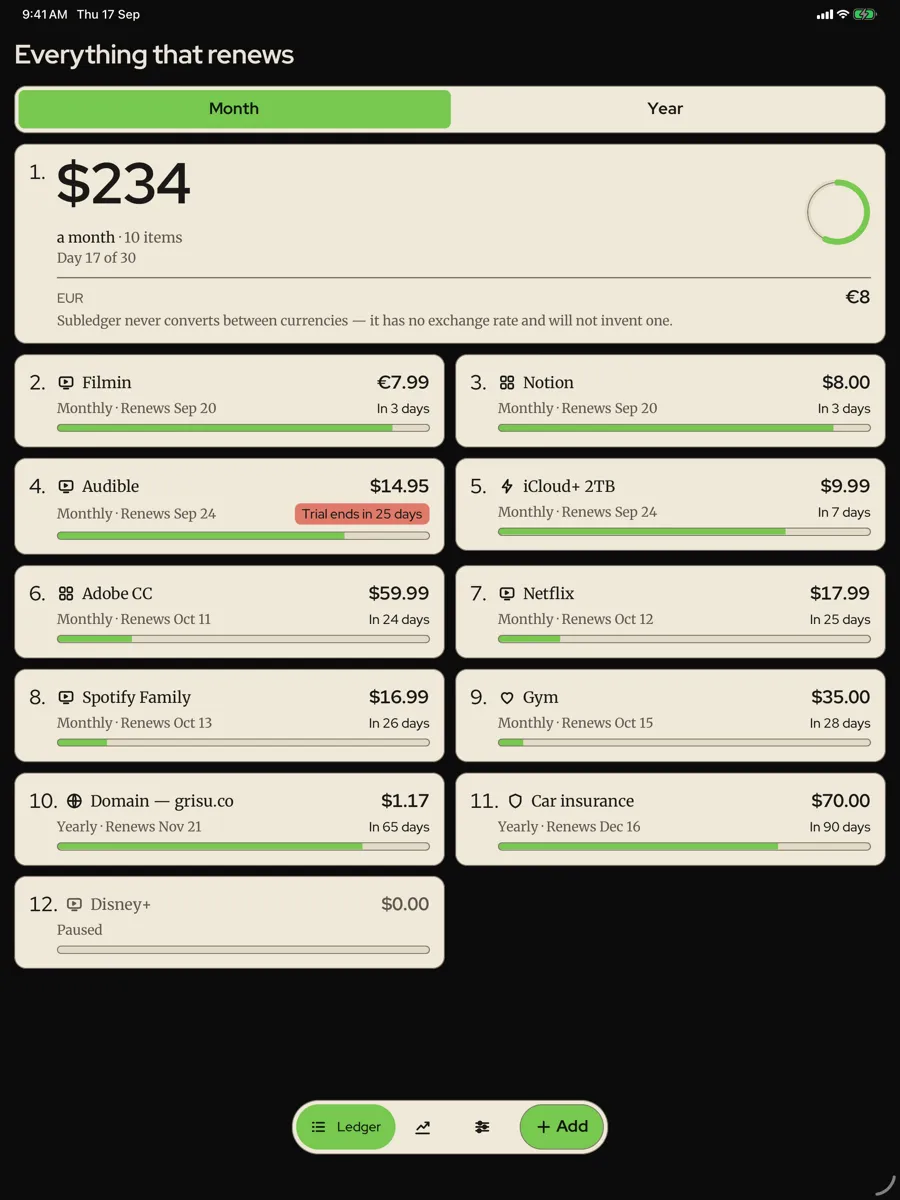
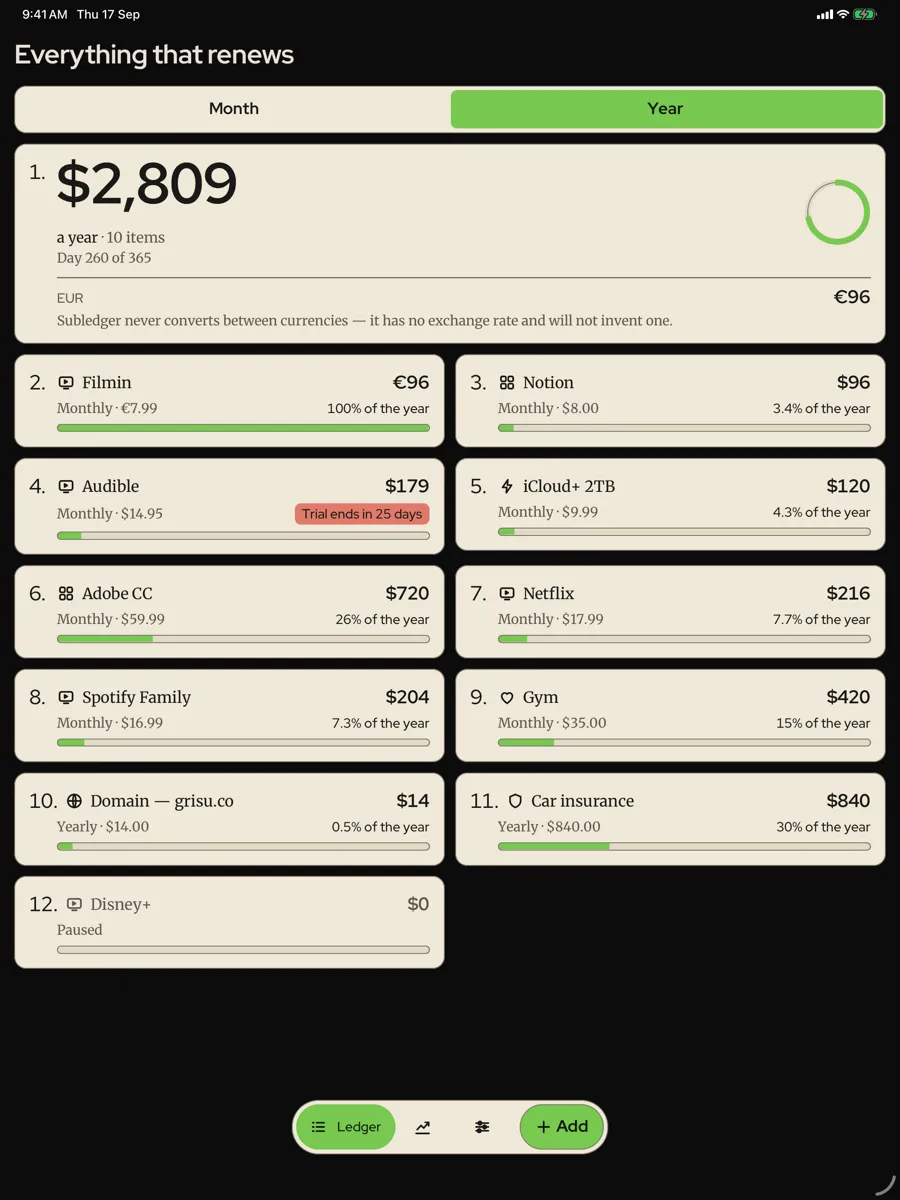
Cada ciclo se normaliza a una cifra anual, con los cargos semanales anualizados a 365,25/7 en lugar del cómodo 52. Se muestra por moneda y nunca se suma entre monedas: no hay tipo de cambio sin conexión, y un total que está mal sin avisar es peor que no tener total
Fechas de cargo que no se desplazan
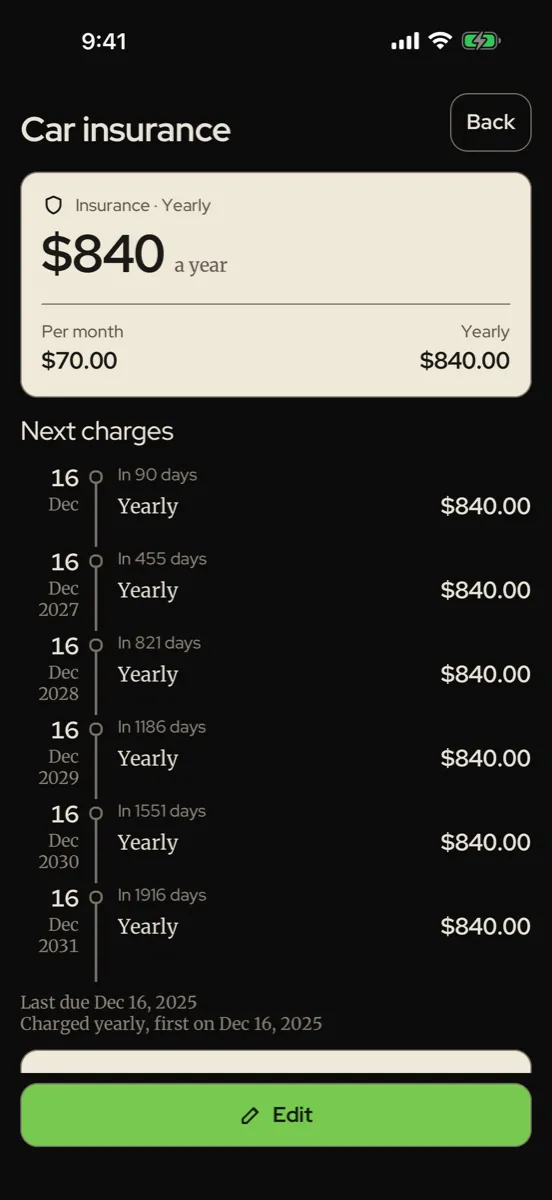
Los cargos se cuentan desde la primera fecha de cobro en lugar de encadenarse desde el último, así que una factura mensual cobrada por primera vez el día 31 da 28 de febrero y luego 31 de marzo, no 28 de marzo para siempre. Los cálculos usan días del calendario civil, así que ningún cambio de hora puede mover un día de cobro
Línea de tiempo de 30 días y desglose por categoría
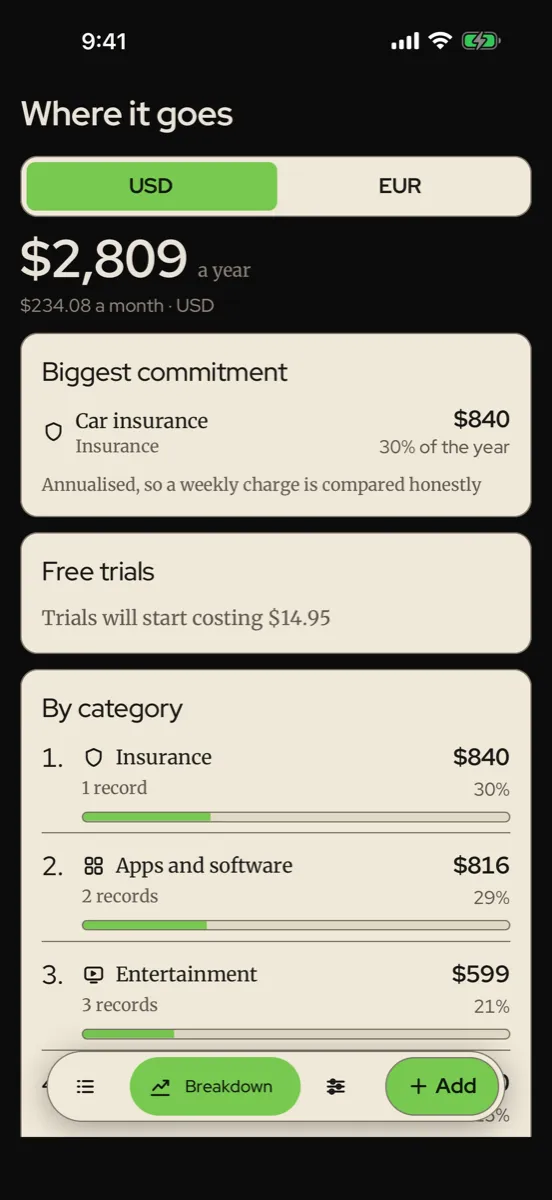
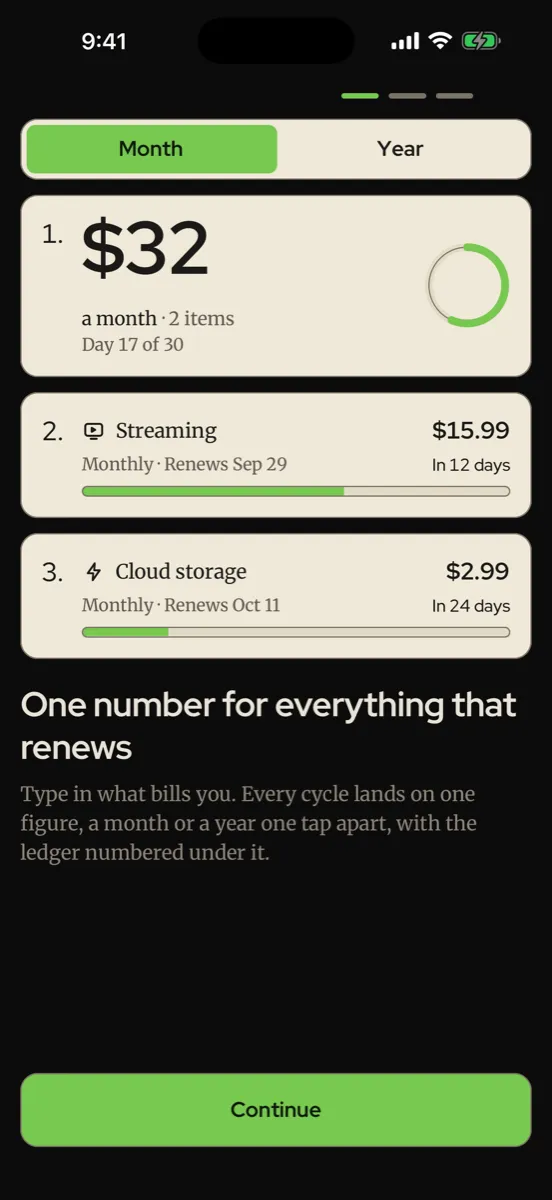
La pantalla de inicio muestra la cifra anual y después una línea de tiempo con fechas de lo que de verdad vence en los próximos treinta días. La pantalla de desglose reparte tu gasto comprometido en once categorías —entretenimiento, software, seguros, dominios, garantías y el resto—, también por moneda
Un solo pago, no una suscripción
Cinco elementos son gratis para siempre, incluidas la cifra anual, la línea de tiempo y los recordatorios de renovación. com.grisu.recur.pro es una única compra que desbloquea elementos ilimitados, los avisos de fin de prueba, el desglose por categoría y la exportación a CSV: un control de suscripciones que cobrara una suscripción sería una broma a tu costa
Capturas
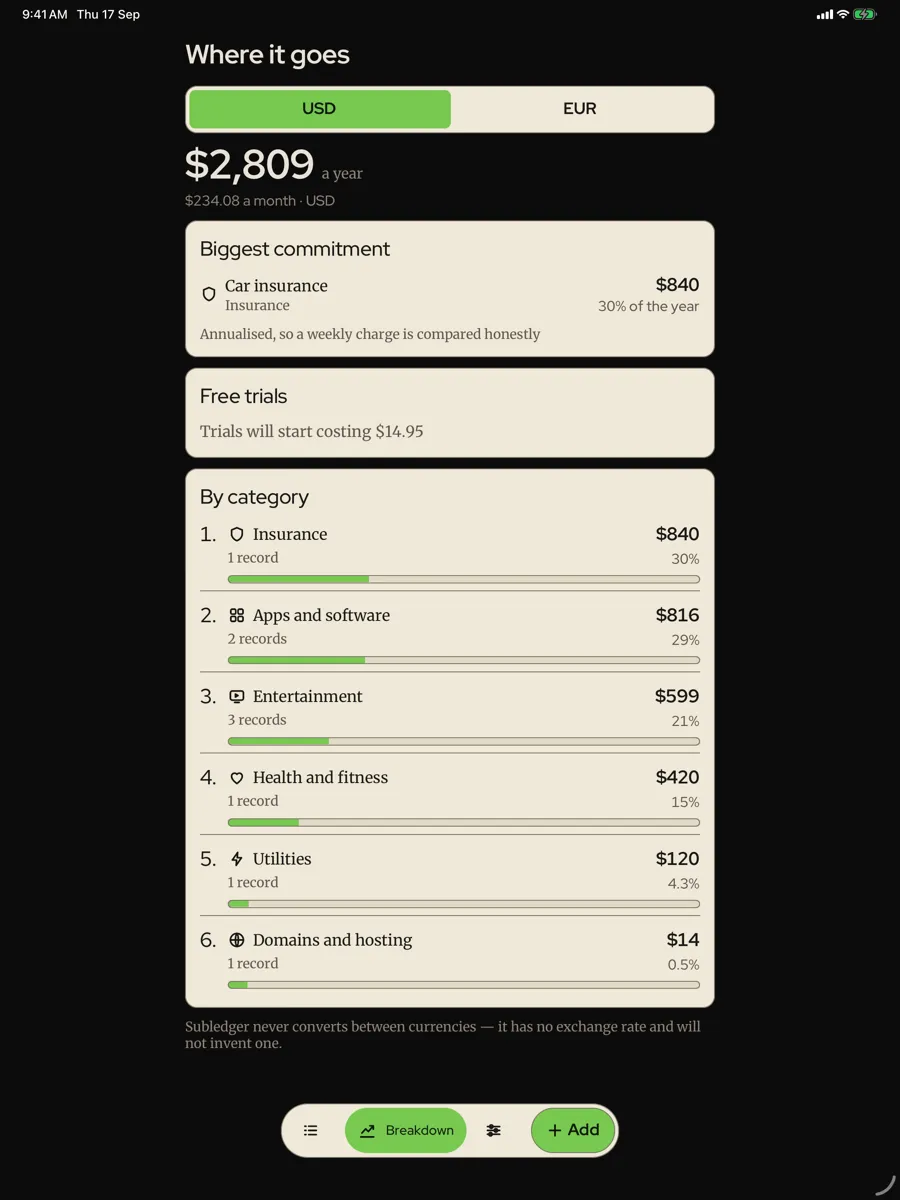
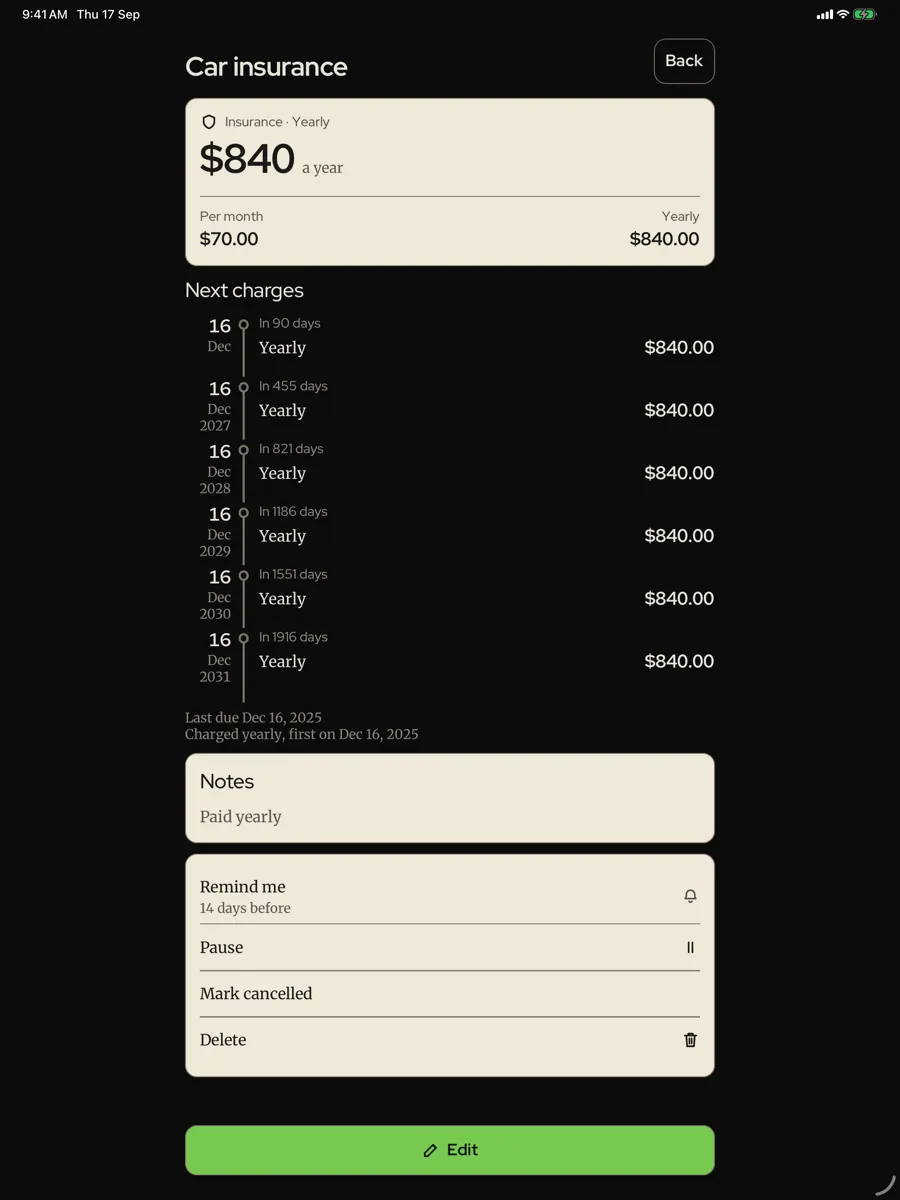
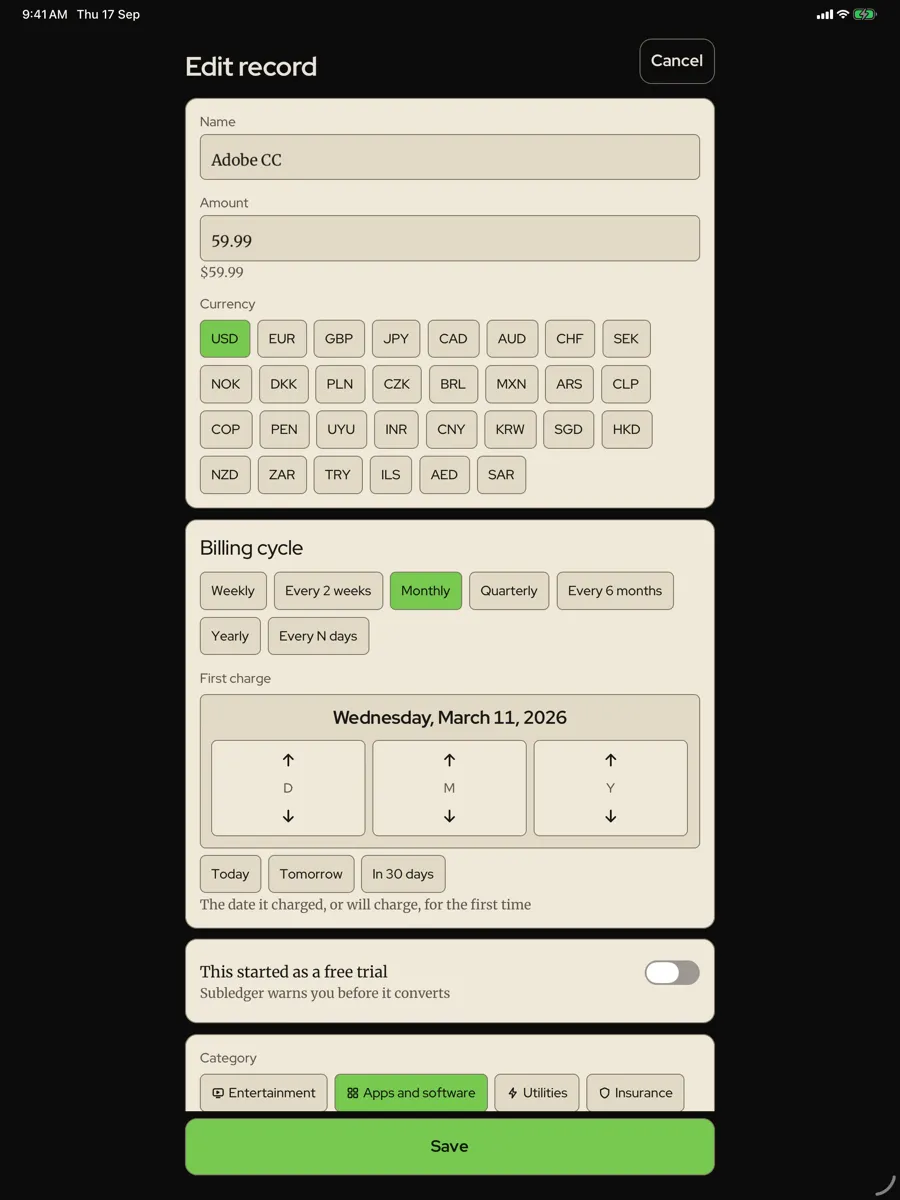
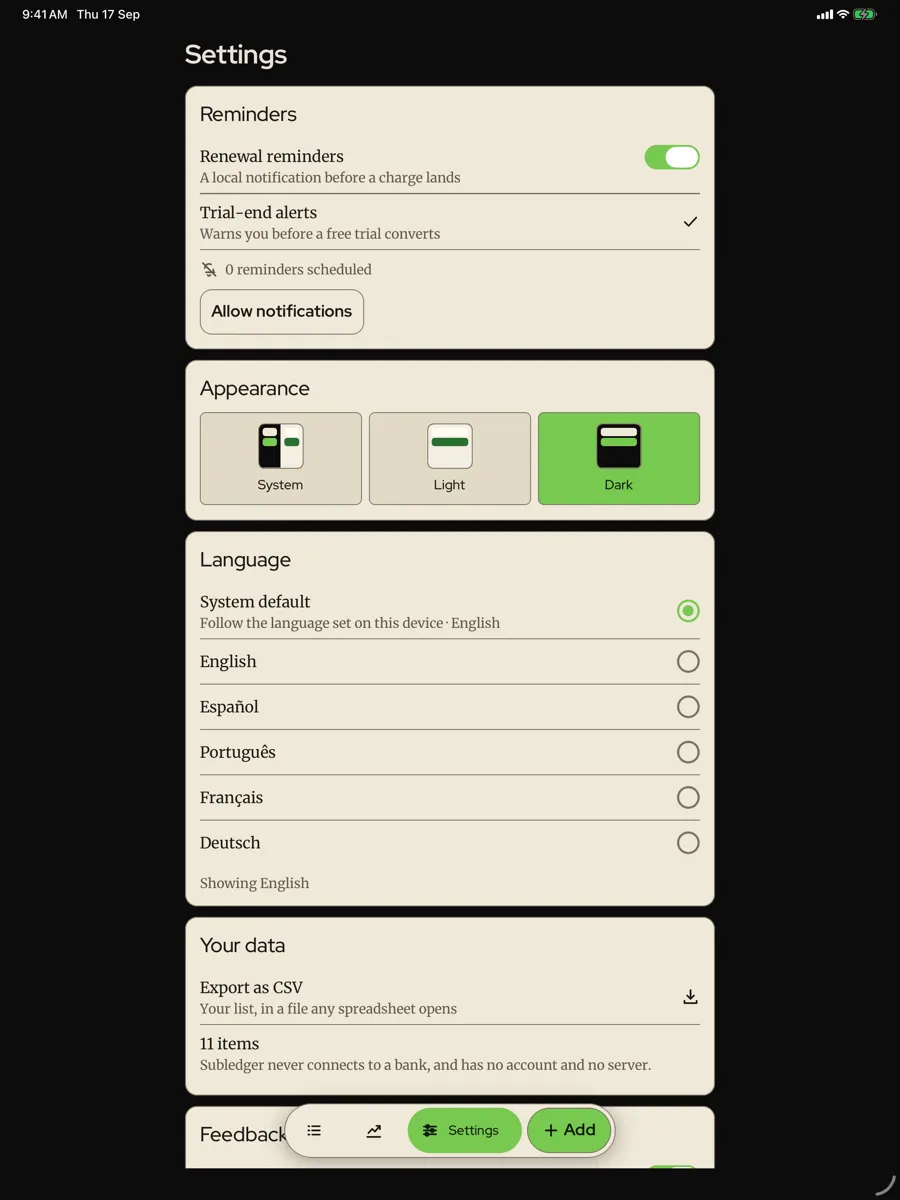
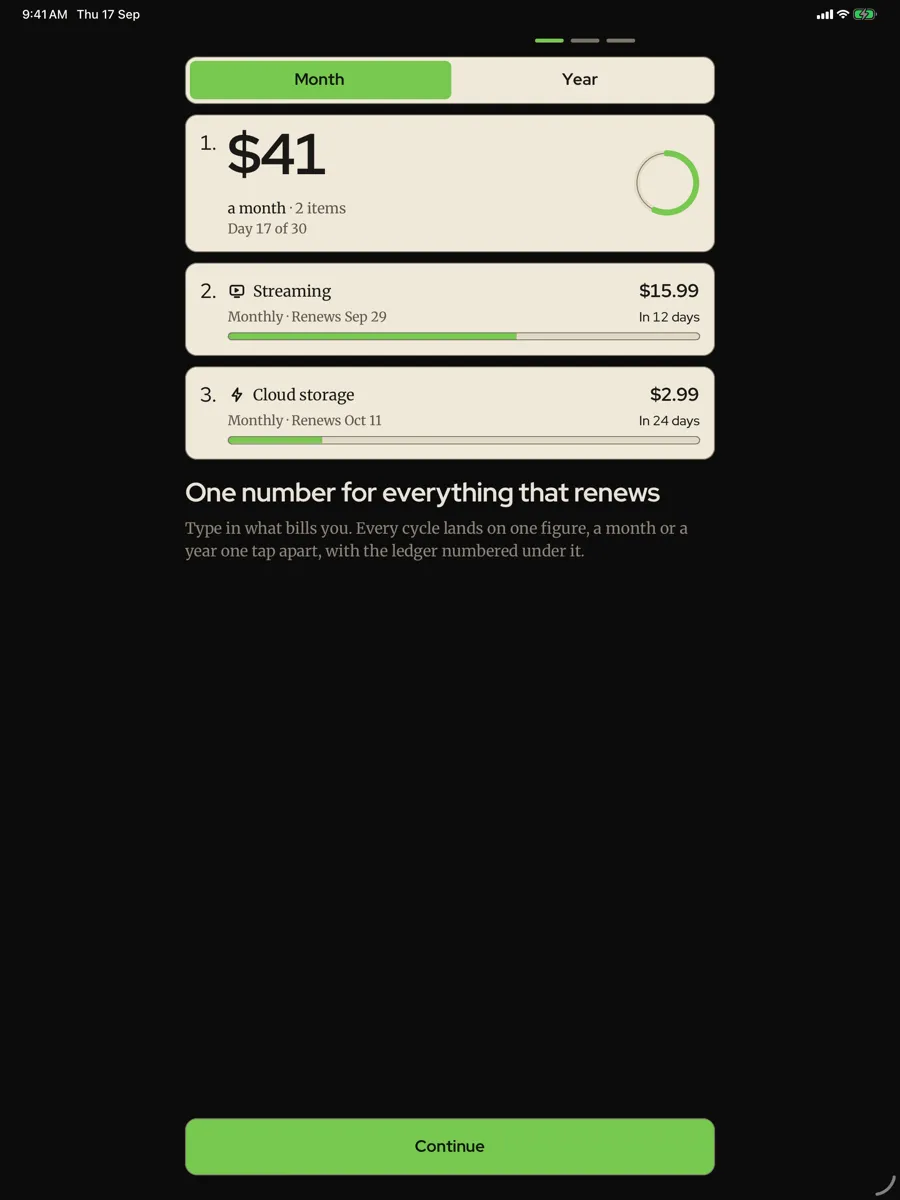
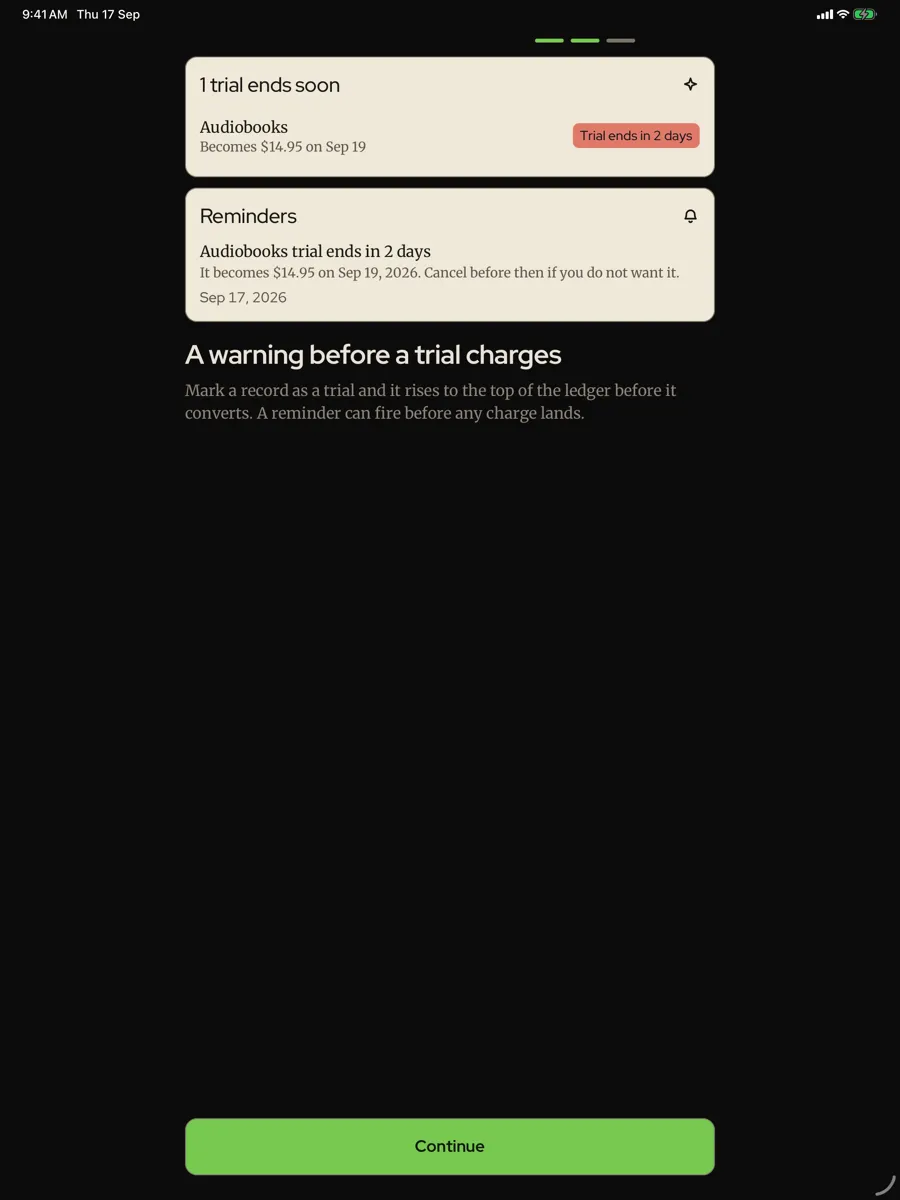
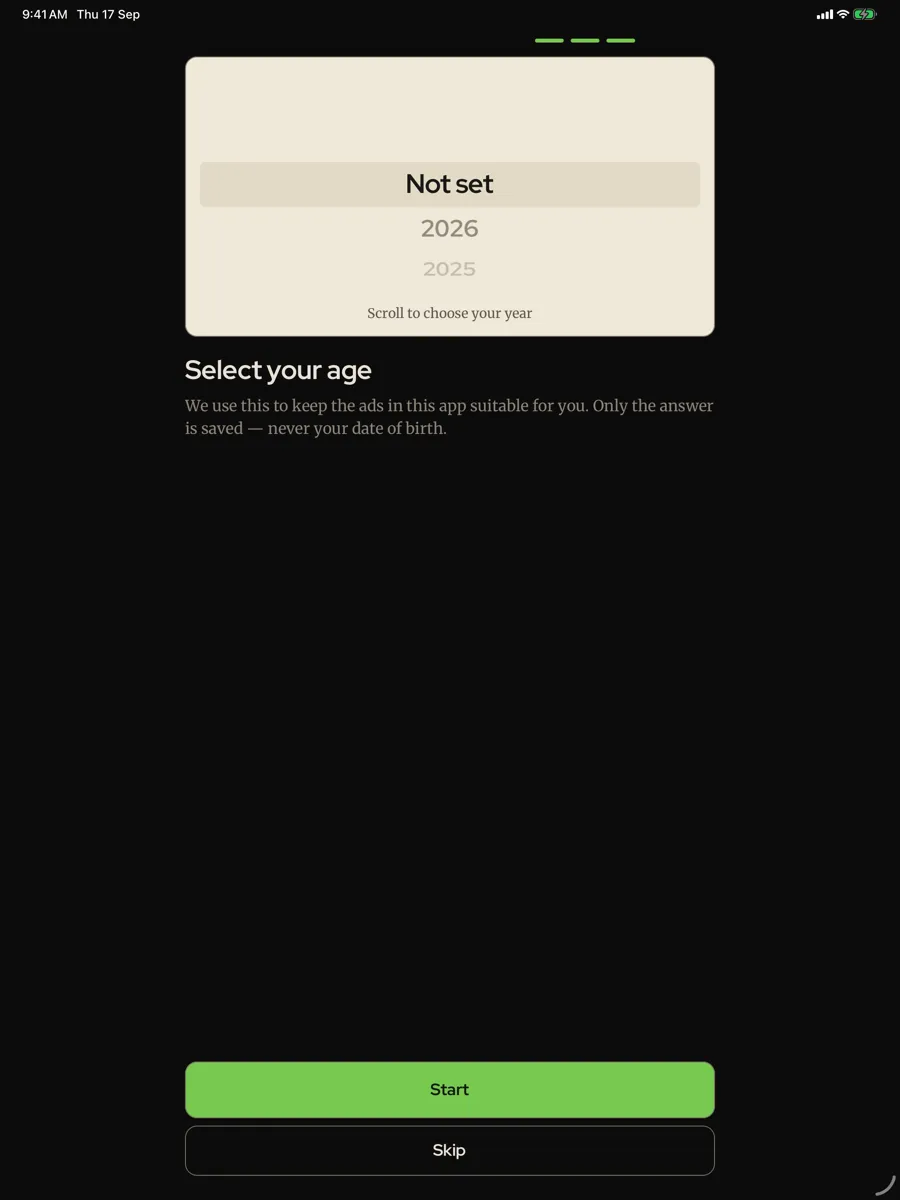
El texto detallado que sigue aún no está traducido y se muestra en inglés.
About Subledger
You already know roughly what you pay every month. Subledger exists to replace roughly with a number — and to do it without ever asking for a bank login.
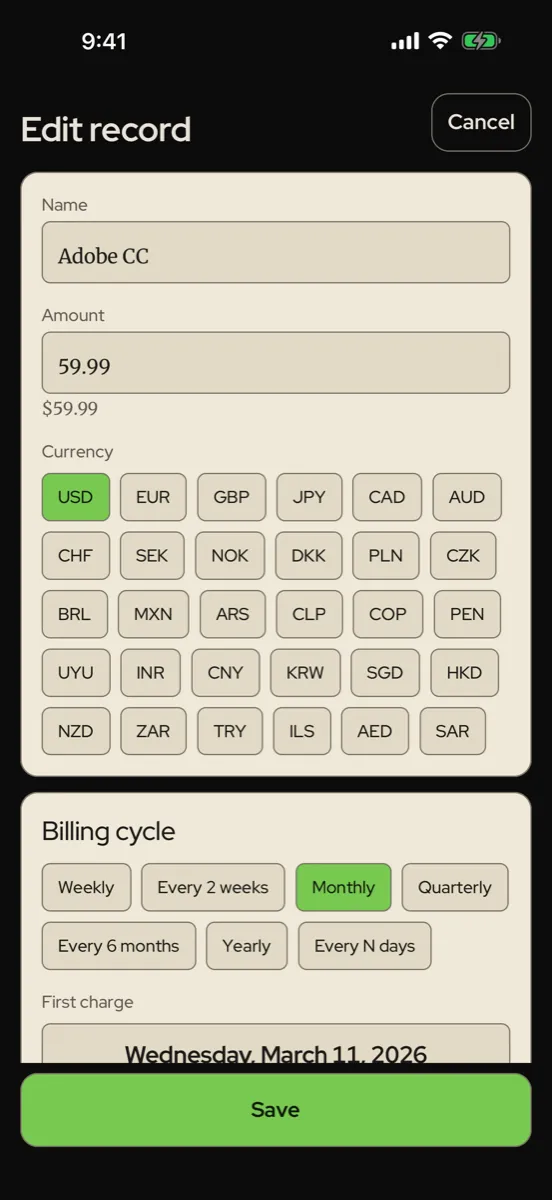
You type each item in: name, amount, currency, cycle, the date it first charged. In return the app gives you the figure that pile of small charges actually adds up to over a year, a dated timeline of what is due in the next thirty days, and a warning before a free trial turns into a charge. Subscriptions, insurance premiums, domain renewals, gym memberships, extended warranties — anything with a next date and a cycle belongs here.
Why it will never connect to your bank
The obvious way to build this app is to read your transactions. The best-known product in the category does exactly that, and charges a monthly fee for the privilege of watching your money move.
Subledger takes the opposite trade deliberately. Typing in a dozen items costs you ten minutes once; handing a third party a live feed of every purchase you make costs you something you cannot get back. So there is no aggregator, no OAuth screen, no read-only credential, no account and no server of ours. Your list lives in a SQLite database inside the app’s private storage, and the only thing that ever leaves the device is a CSV file you explicitly asked to export and then chose where to send.
That is not a feature we can quietly drop in a later version. There is nothing to switch on: the app was written without the network path in the first place.
The number, and why it refuses to lie to you
A list of “$4.99 a month”, “£12 a quarter” and “€89 a year” is not readable as a commitment. Normalising all of it to one per-year figure is the single transformation that makes the total something you can react to, and it is the largest thing on the home screen.
Two decisions keep that number honest. Weekly charges are annualised at 365.25 ÷ 7, not 52 — a weekly bill charges 52.18 times a year, and the comfortable answer under-reports exactly the cycles people already underestimate. And nothing is ever summed across currencies. The app has no exchange rate, because it has no network to get one from, and a rate baked in at build time would be wrong within a week. So dollars, euros and pounds are reported side by side, per currency, and the code will throw rather than produce a plausible-looking total that mixes them.
Dates computed the boring way
The arithmetic underneath uses no timestamp at all. A billing date here is a civil calendar date — a year, a month and a day, with no time and no zone — and every calculation is exact integer maths over a day count. A daylight-saving transition has nothing to shift.
Occurrences are also indexed from the anchor rather than chained from the previous one, which is what stops the classic drift: a monthly bill first charged on 31 January falls on 28 February and then back on 31 March, instead of quietly moving to the 28th for the rest of its life. The same logic drives the timeline, the annualised cost and the reminder schedule.
Currency symbols, decimal places and date formats come from your device rather than from a hardcoded assumption, so an amount typed as 1.234,56 and one typed as 1,234.56 reach the same number.
What it costs
Five tracked items are free, permanently — enough to see the number the app exists to show. One payment unlocks unlimited items, the trial-end alerts, the category breakdown and CSV export. Not a subscription: for this app in particular, that matters.
The free tier carries ads from Google AdMob, which is the one thing that sends anything off your device. What that involves is set out plainly in the privacy policy.


Más apps como Subledger
-

Aubade: Daily Affirmations
Una frase al día, sobre papel y en tu pantalla de inicio.
-

Valise: Trip Planner & Split
El plan, el mapa y el dinero de un viaje, en una maleta en tu teléfono.
-

Quadrille: QR Scanner & Maker
Códigos QR como objetos de diseño: dales estilo, escanéalos, guárdalos.
-

Paid in Full: Debt Free Date
Mira tu fecha sin deudas, lo que cuestan los intereses y comisiones, y sigue cada pago.