Subledger: Subscription Log
Tout ce qui se renouvelle, sans connexion bancaire.
- IOS
- ANDROID
- Utilitaire
- Disponible


À propos de Subledger
Un suivi manuel de tout ce qui se renouvelle : abonnements, assurances, noms de domaine, adhésions, garanties. L'application ne se connecte jamais à une banque : vous saisissez ce que vous payez, et elle transforme un empilement de montants mensuels et trimestriels en un seul chiffre annuel honnête, présenté par devise et jamais additionné entre devises. Des alertes vous préviennent avant qu'un essai gratuit ne devienne payant. Les dates de prélèvement reposent sur une arithmétique de calendrier qu'aucun changement d'heure ne peut décaler, et tout reste sur votre appareil.
Fonctionnalités
Aucune connexion bancaire, jamais
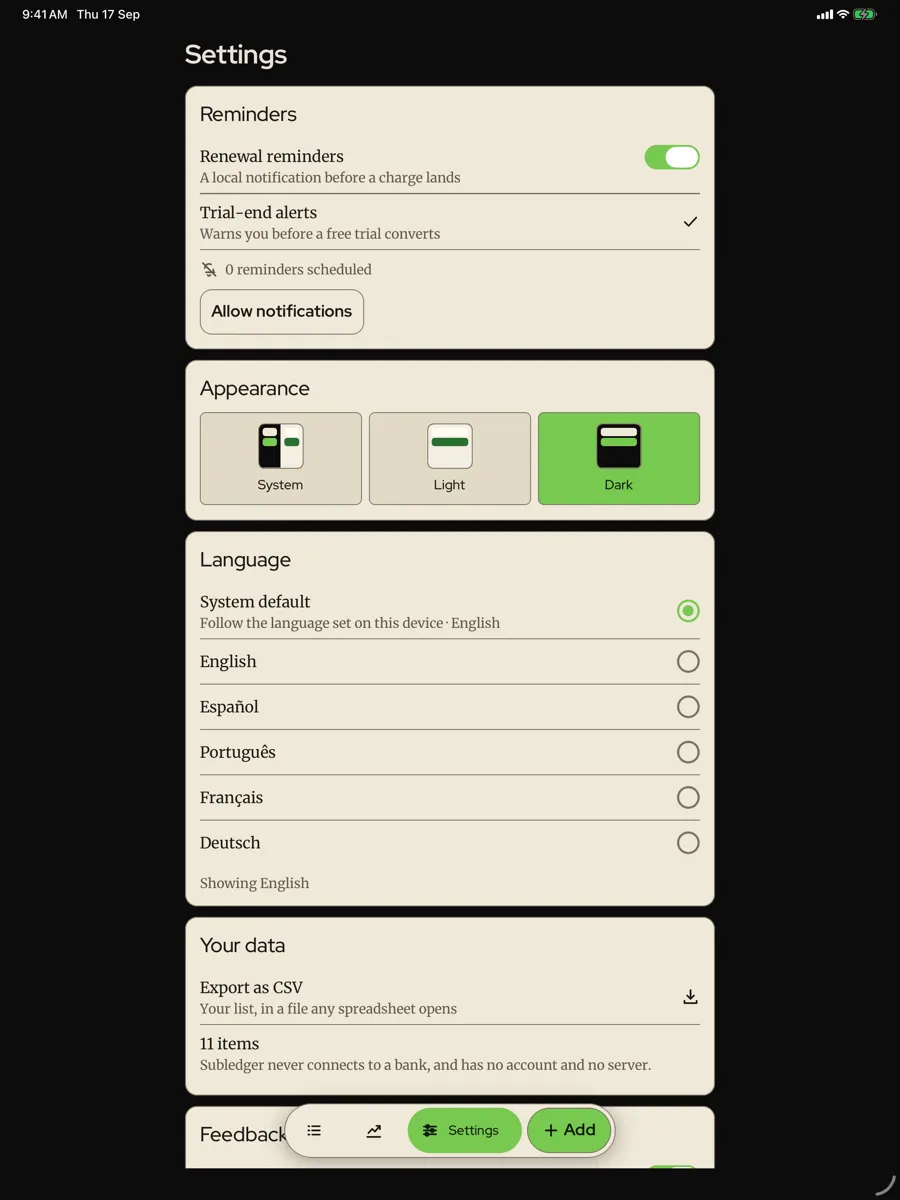
Vous saisissez chaque élément vous-même. Pas de compte, pas de connexion, pas de serveur à nous et aucun accès en lecture seule à un établissement — l'app n'a nulle part où envoyer votre liste, même si elle le voulait, et c'est pourquoi la promesse est vérifiable plutôt que simplement affirmée
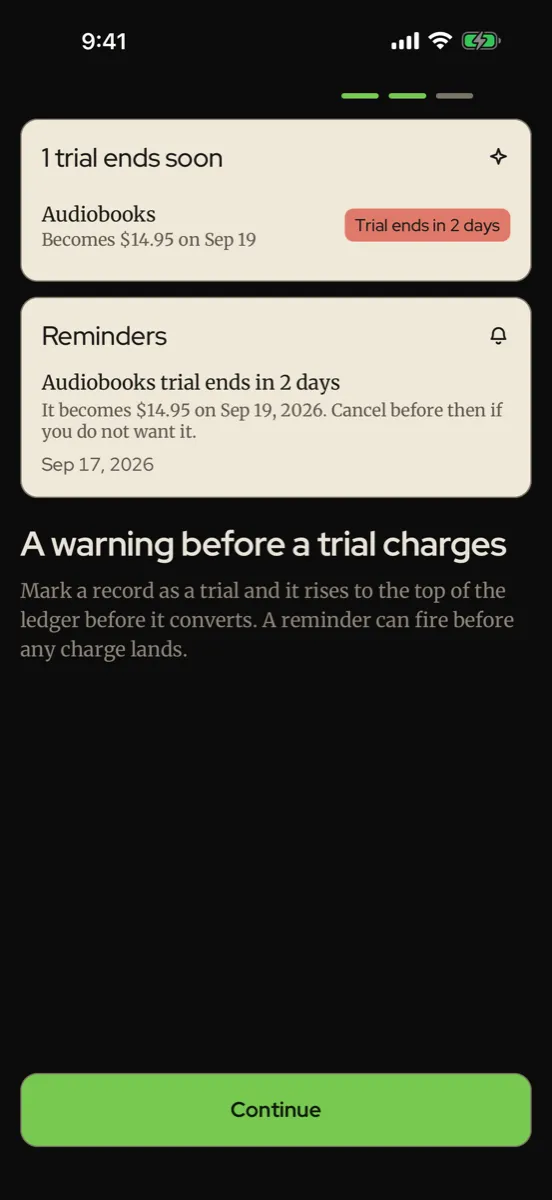
Alertes de fin d'essai
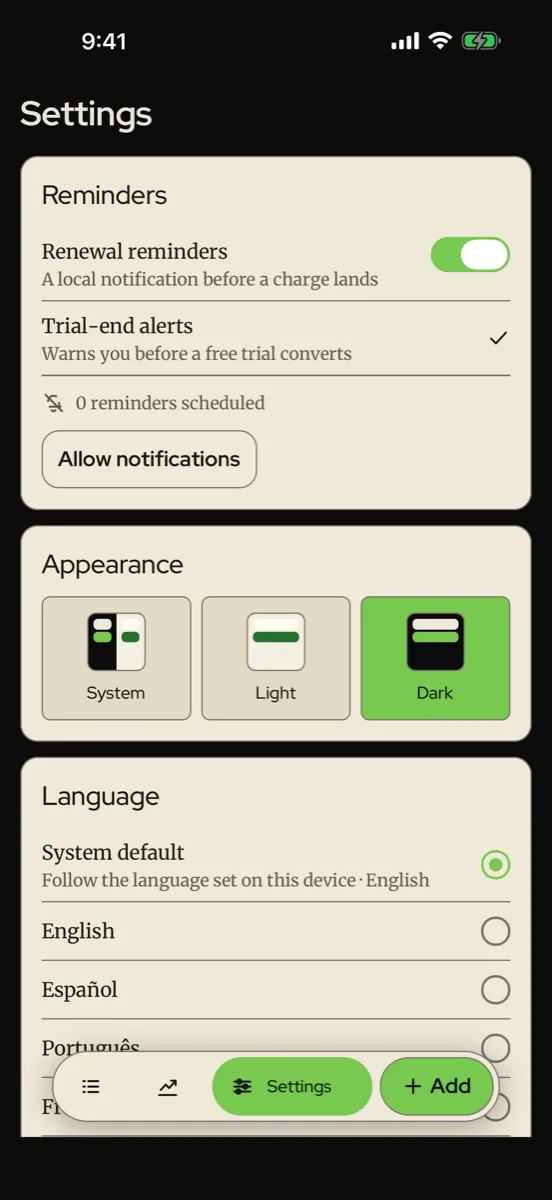
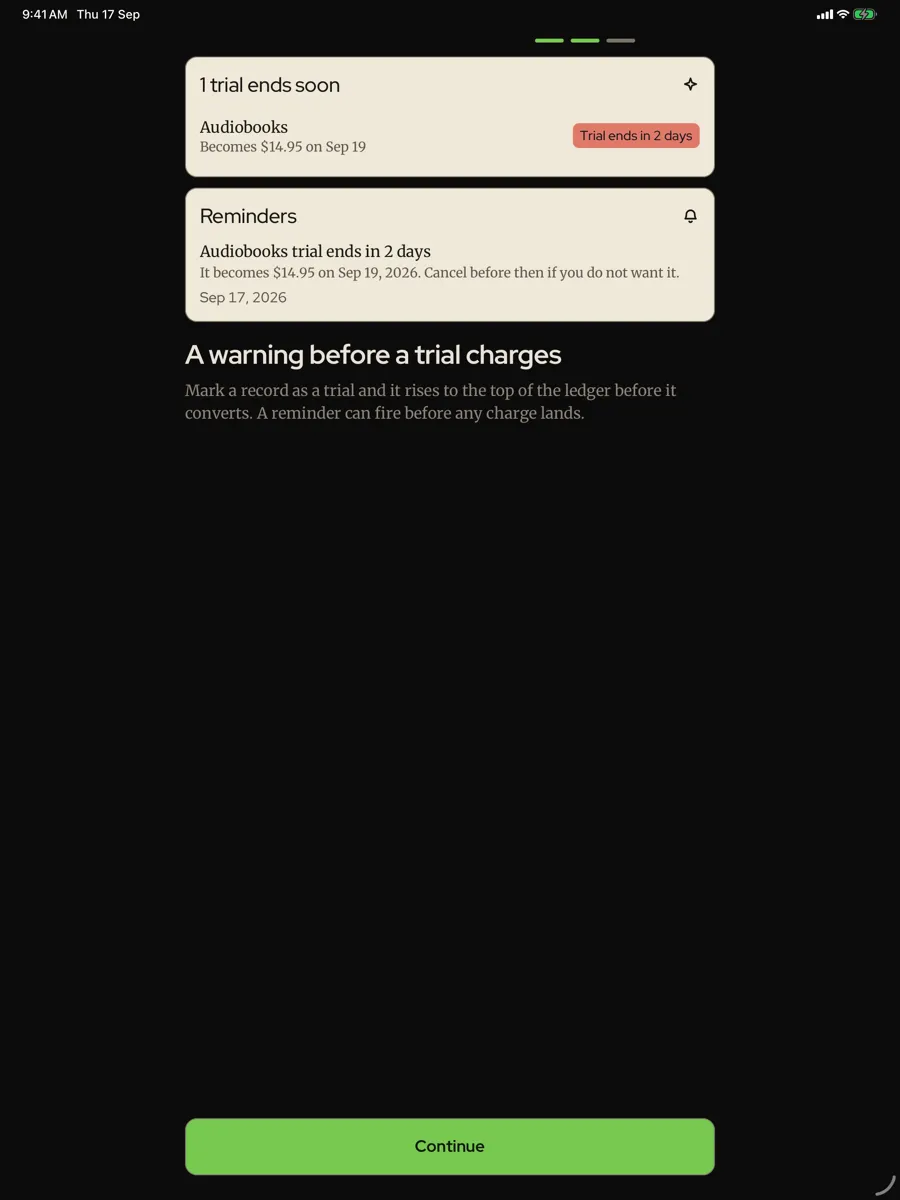
Marquez un élément comme essai avec une date de fin : l'app le met en avant sur l'écran d'accueil et programme une notification locale deux jours avant, par défaut — pas un seul, car un essai qui devient payant demain a peut-être déjà dépassé la date limite de résiliation du fournisseur
Le chiffre annuel honnête
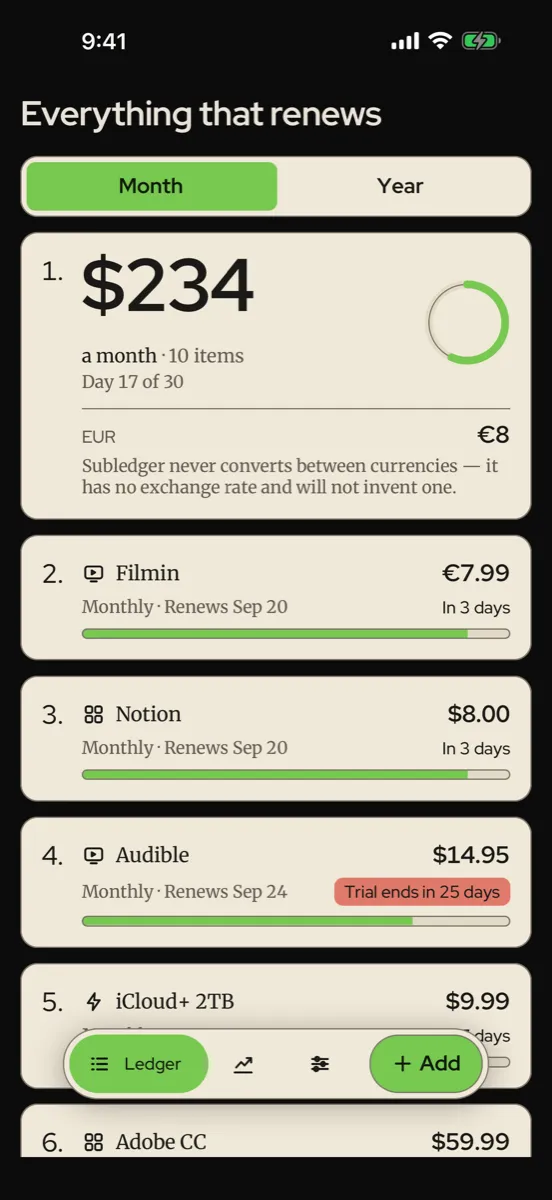
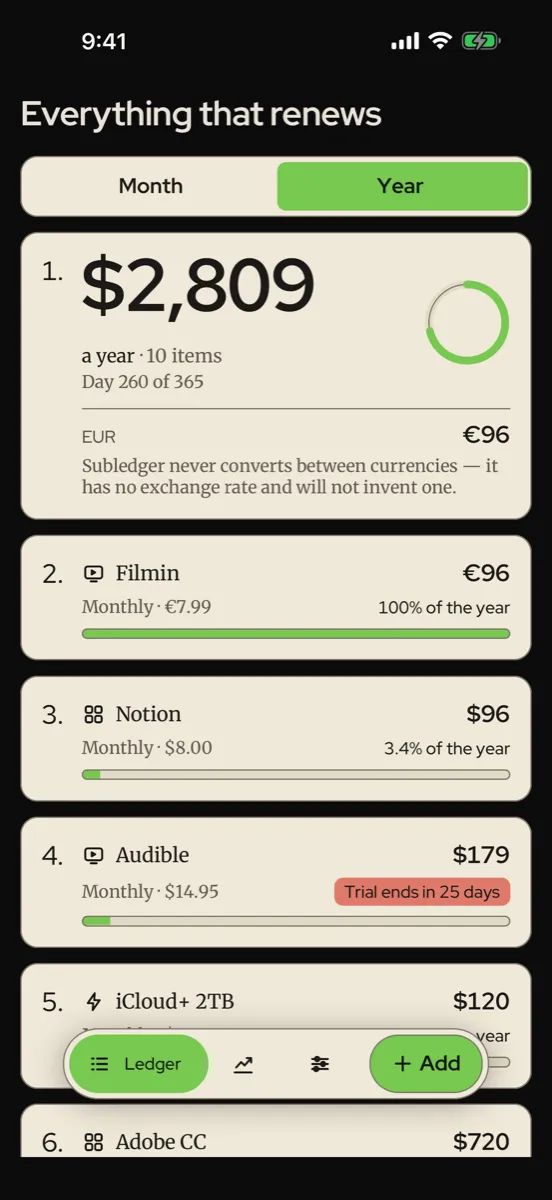
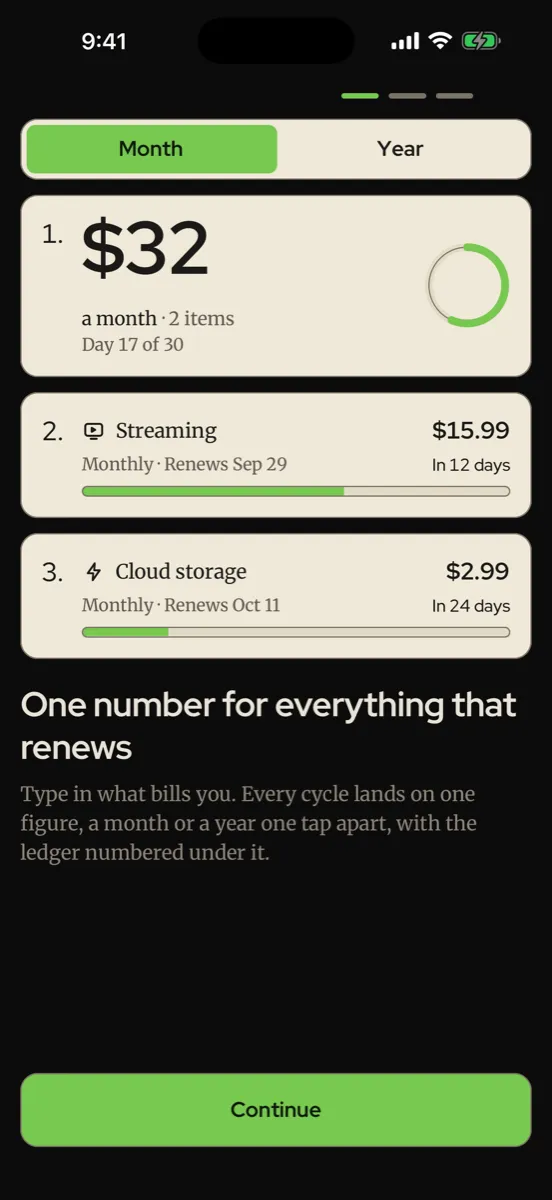
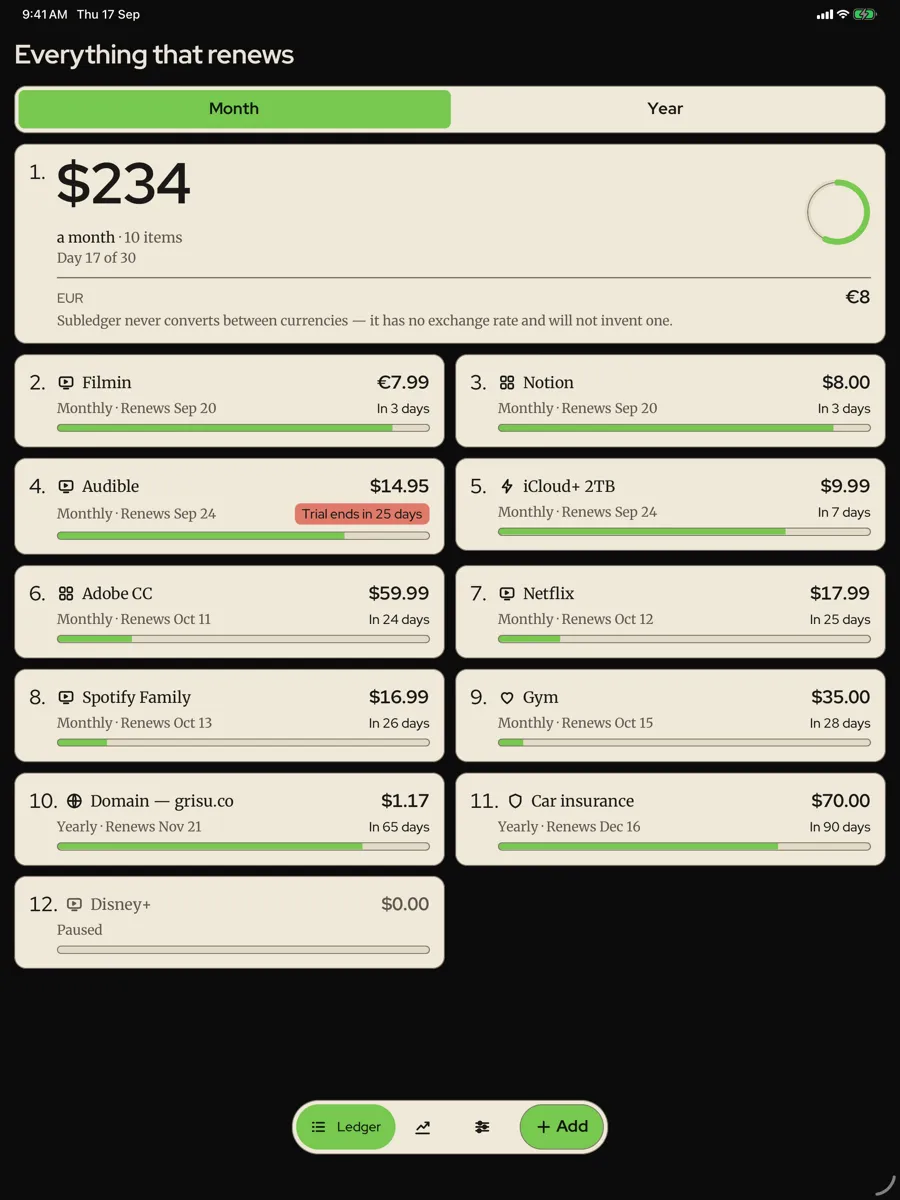
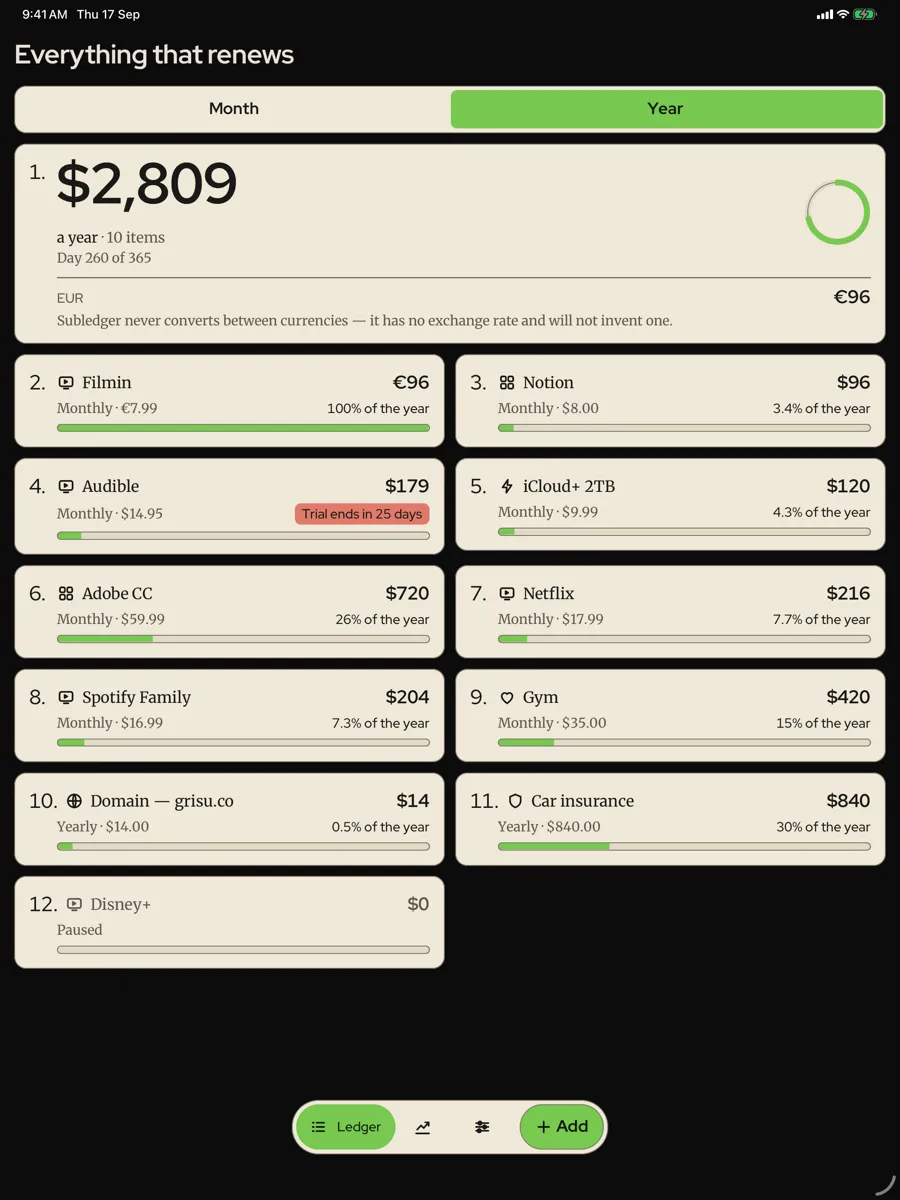
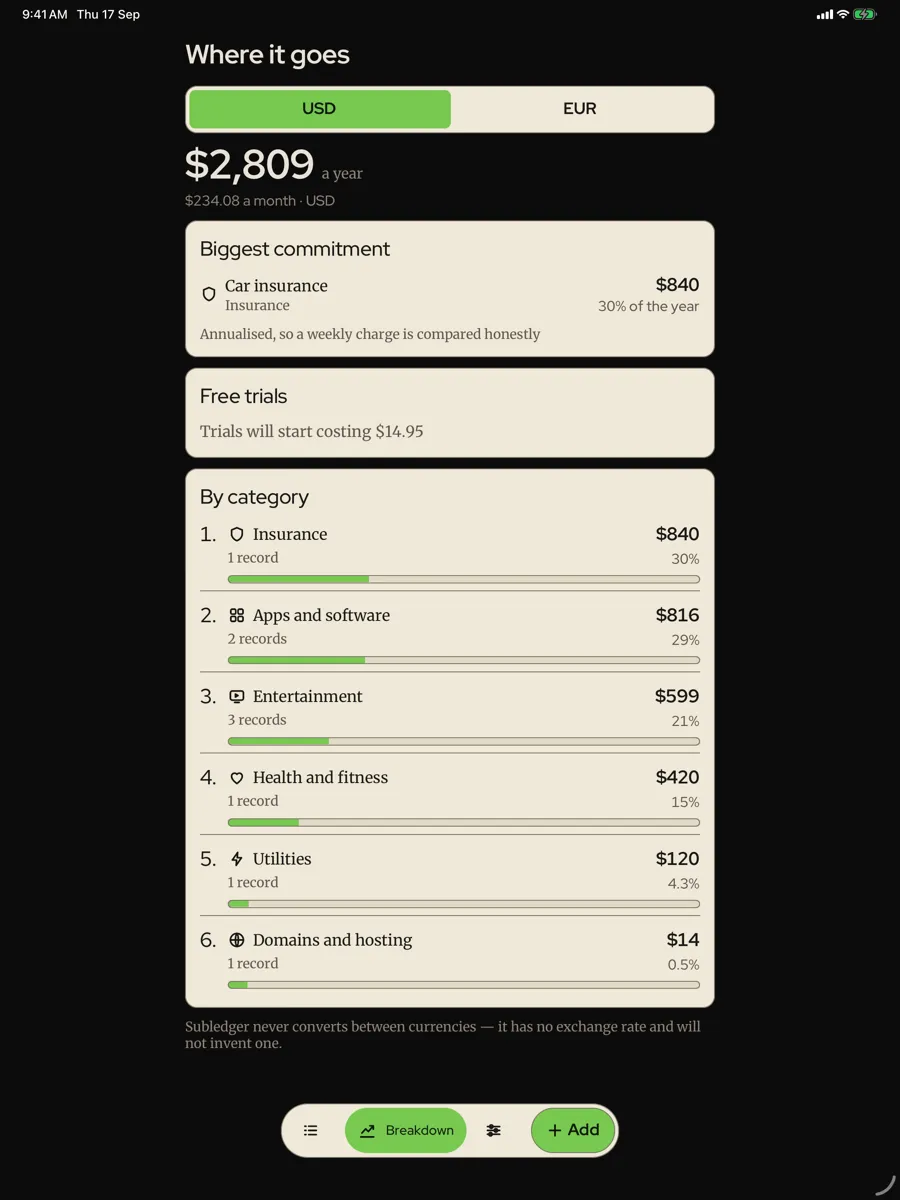
Chaque cycle est ramené à un montant annuel, les prélèvements hebdomadaires étant annualisés à 365,25/7 plutôt qu'au confortable 52. Il est présenté par devise et jamais additionné entre devises : il n'y a pas de taux de change hors ligne, et un total faux sans le dire est pire que pas de total du tout
Des dates de prélèvement qui ne dérivent pas
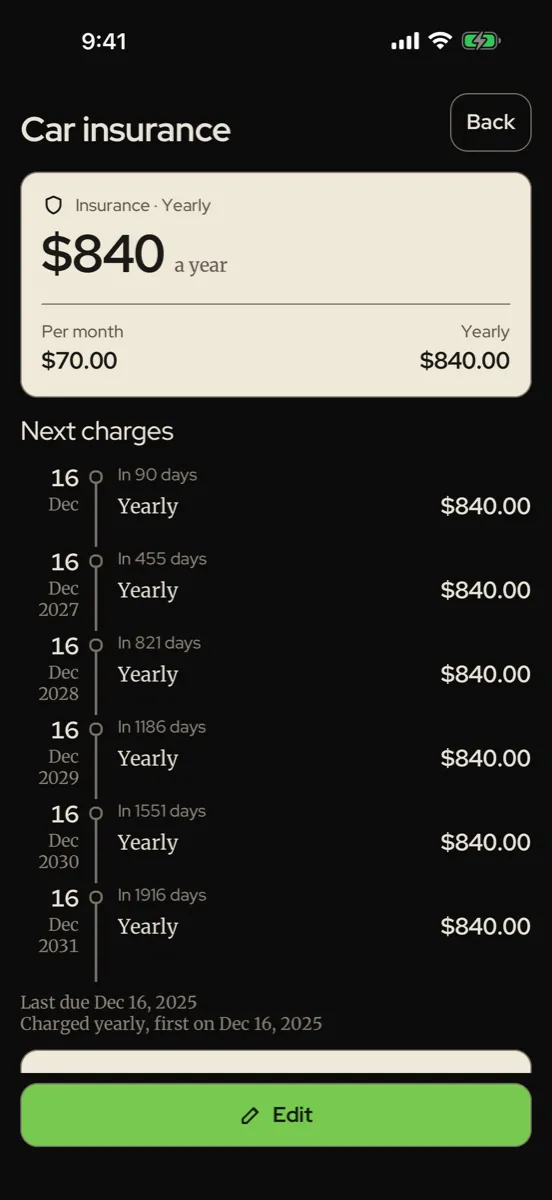
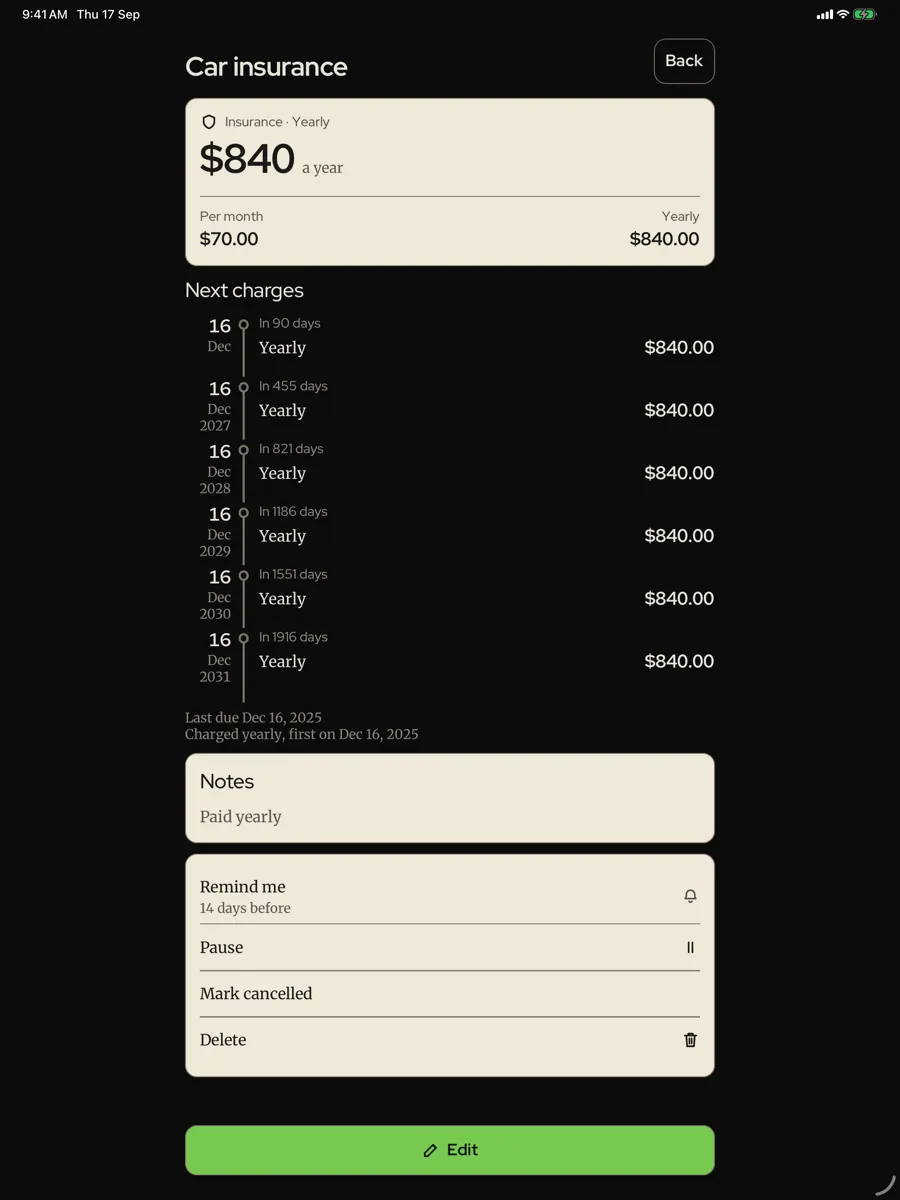
Les échéances sont calculées à partir de la première date de prélèvement au lieu d'être enchaînées depuis la dernière : une facture mensuelle prélevée pour la première fois le 31 donne le 28 février puis le 31 mars — et non le 28 mars pour toujours. Le calcul se fait en jours du calendrier civil, si bien qu'aucun changement d'heure ne peut déplacer un jour de prélèvement
Chronologie sur 30 jours et répartition par catégorie
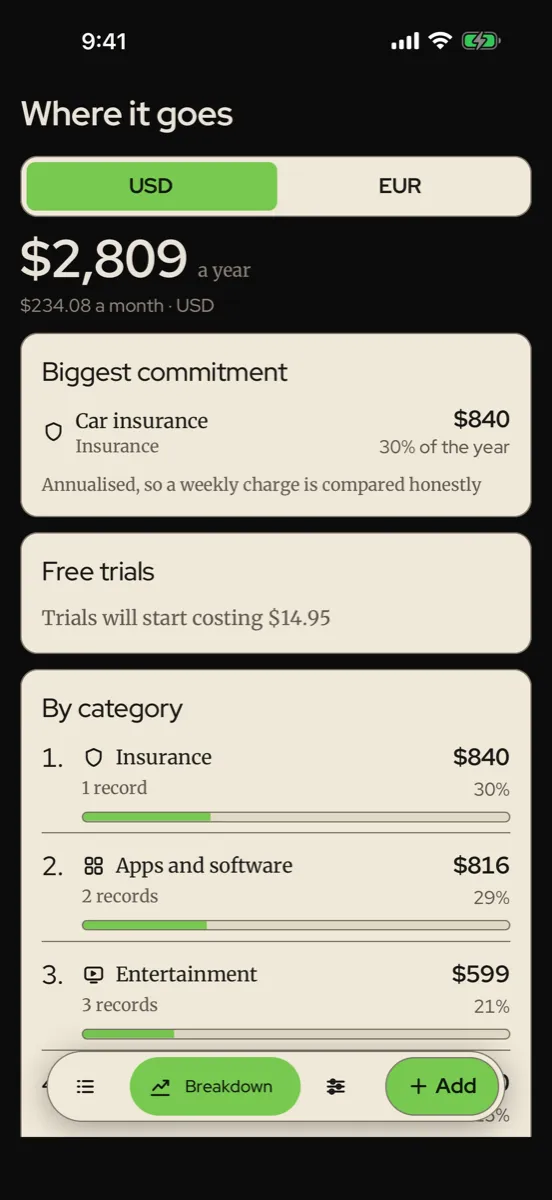
L'écran d'accueil affiche le chiffre annuel, puis une chronologie datée de ce qui arrive réellement à échéance dans les trente prochains jours. L'écran de répartition ventile vos engagements entre onze catégories — divertissement, logiciels, assurances, noms de domaine, garanties et le reste — là encore par devise
Un paiement unique, pas un abonnement
Cinq éléments suivis sont gratuits pour toujours, avec le chiffre annuel, la chronologie et les rappels de renouvellement. com.grisu.recur.pro est un achat unique qui débloque les éléments illimités, les alertes de fin d'essai, la répartition par catégorie et l'export CSV — un gestionnaire d'abonnements qui vous ferait payer un abonnement serait une blague à vos dépens
Captures d'écran
Le descriptif détaillé ci-dessous n'est pas encore traduit et s'affiche en anglais.
About Subledger
You already know roughly what you pay every month. Subledger exists to replace roughly with a number — and to do it without ever asking for a bank login.
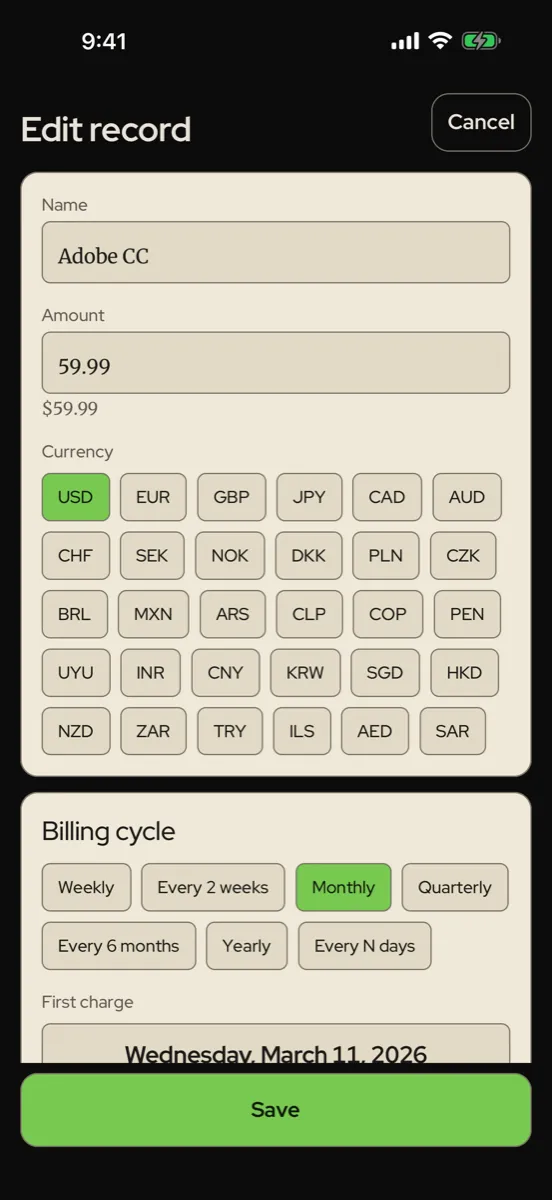
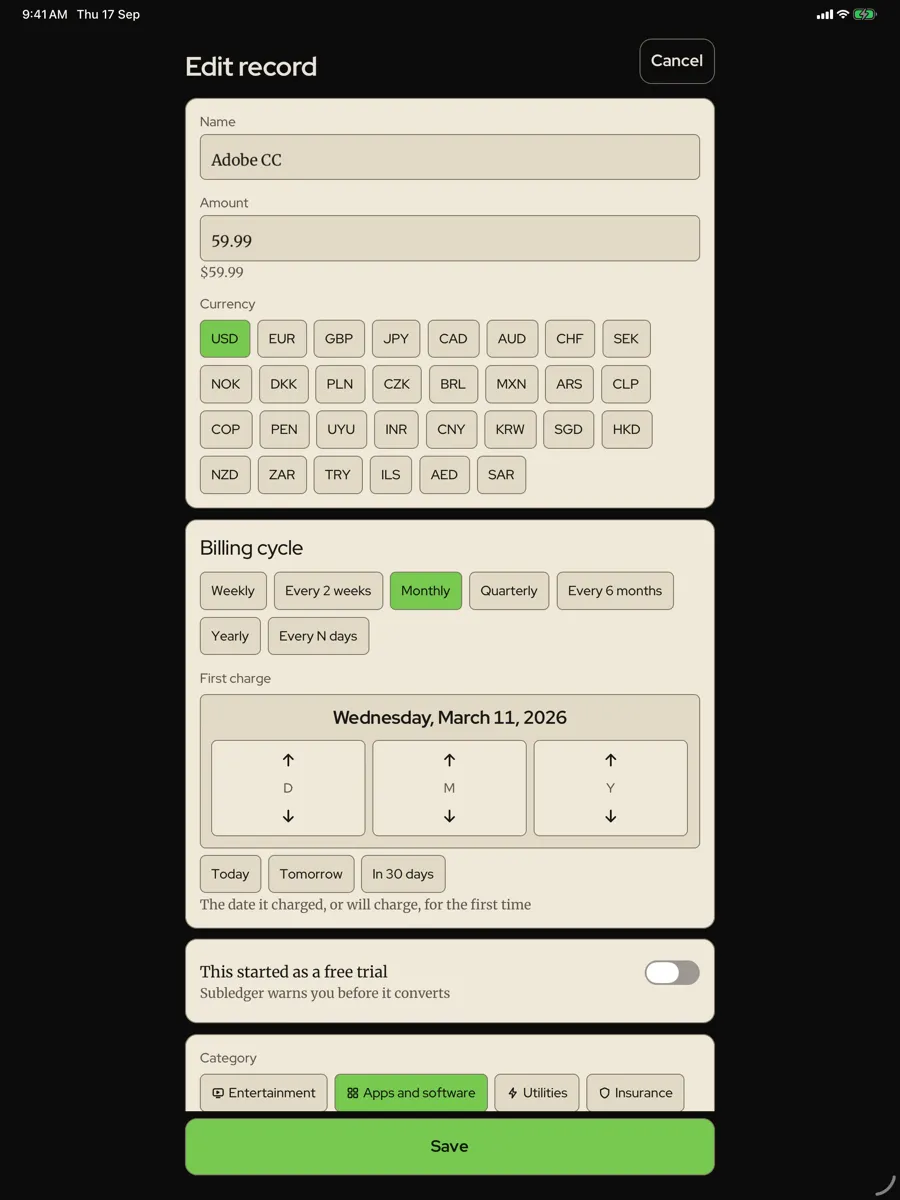
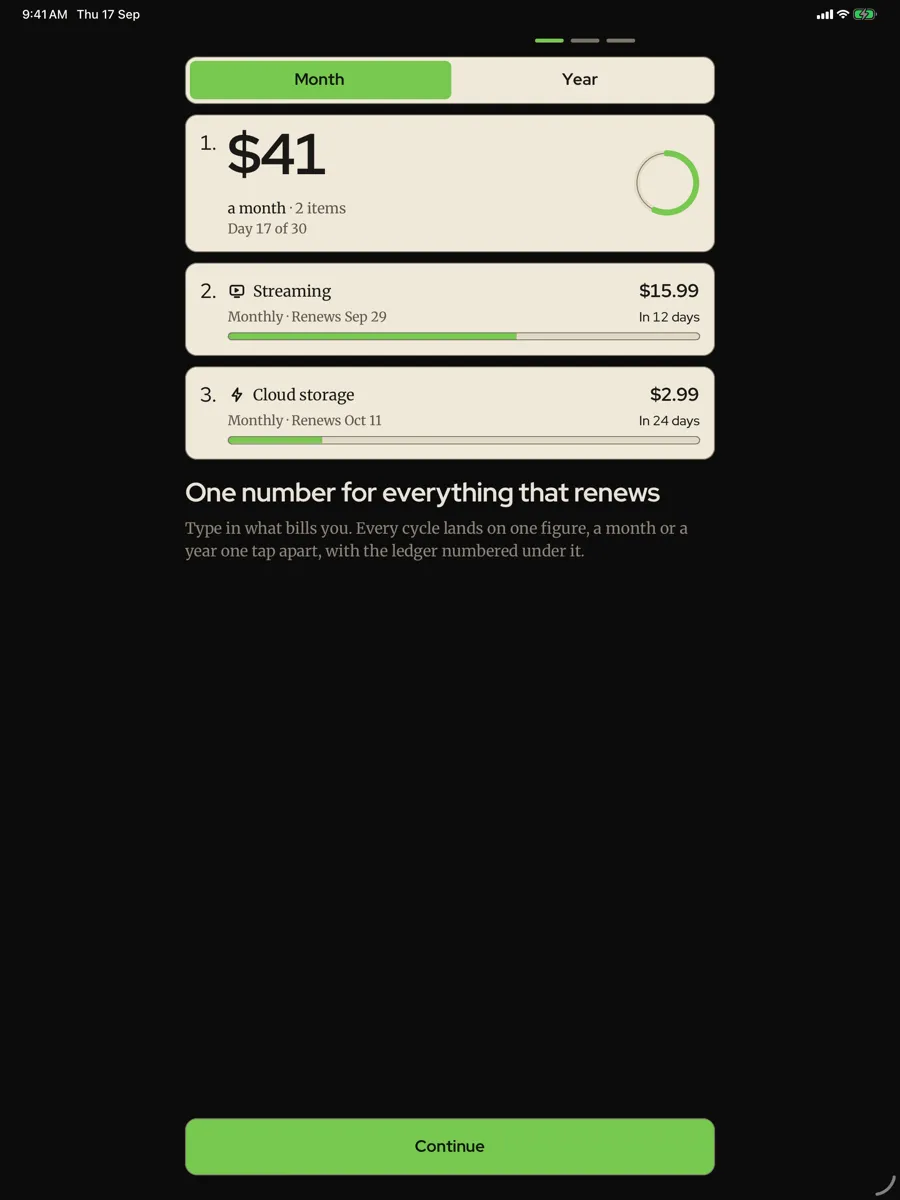
You type each item in: name, amount, currency, cycle, the date it first charged. In return the app gives you the figure that pile of small charges actually adds up to over a year, a dated timeline of what is due in the next thirty days, and a warning before a free trial turns into a charge. Subscriptions, insurance premiums, domain renewals, gym memberships, extended warranties — anything with a next date and a cycle belongs here.
Why it will never connect to your bank
The obvious way to build this app is to read your transactions. The best-known product in the category does exactly that, and charges a monthly fee for the privilege of watching your money move.
Subledger takes the opposite trade deliberately. Typing in a dozen items costs you ten minutes once; handing a third party a live feed of every purchase you make costs you something you cannot get back. So there is no aggregator, no OAuth screen, no read-only credential, no account and no server of ours. Your list lives in a SQLite database inside the app’s private storage, and the only thing that ever leaves the device is a CSV file you explicitly asked to export and then chose where to send.
That is not a feature we can quietly drop in a later version. There is nothing to switch on: the app was written without the network path in the first place.
The number, and why it refuses to lie to you
A list of “$4.99 a month”, “£12 a quarter” and “€89 a year” is not readable as a commitment. Normalising all of it to one per-year figure is the single transformation that makes the total something you can react to, and it is the largest thing on the home screen.
Two decisions keep that number honest. Weekly charges are annualised at 365.25 ÷ 7, not 52 — a weekly bill charges 52.18 times a year, and the comfortable answer under-reports exactly the cycles people already underestimate. And nothing is ever summed across currencies. The app has no exchange rate, because it has no network to get one from, and a rate baked in at build time would be wrong within a week. So dollars, euros and pounds are reported side by side, per currency, and the code will throw rather than produce a plausible-looking total that mixes them.
Dates computed the boring way
The arithmetic underneath uses no timestamp at all. A billing date here is a civil calendar date — a year, a month and a day, with no time and no zone — and every calculation is exact integer maths over a day count. A daylight-saving transition has nothing to shift.
Occurrences are also indexed from the anchor rather than chained from the previous one, which is what stops the classic drift: a monthly bill first charged on 31 January falls on 28 February and then back on 31 March, instead of quietly moving to the 28th for the rest of its life. The same logic drives the timeline, the annualised cost and the reminder schedule.
Currency symbols, decimal places and date formats come from your device rather than from a hardcoded assumption, so an amount typed as 1.234,56 and one typed as 1,234.56 reach the same number.
What it costs
Five tracked items are free, permanently — enough to see the number the app exists to show. One payment unlocks unlimited items, the trial-end alerts, the category breakdown and CSV export. Not a subscription: for this app in particular, that matters.
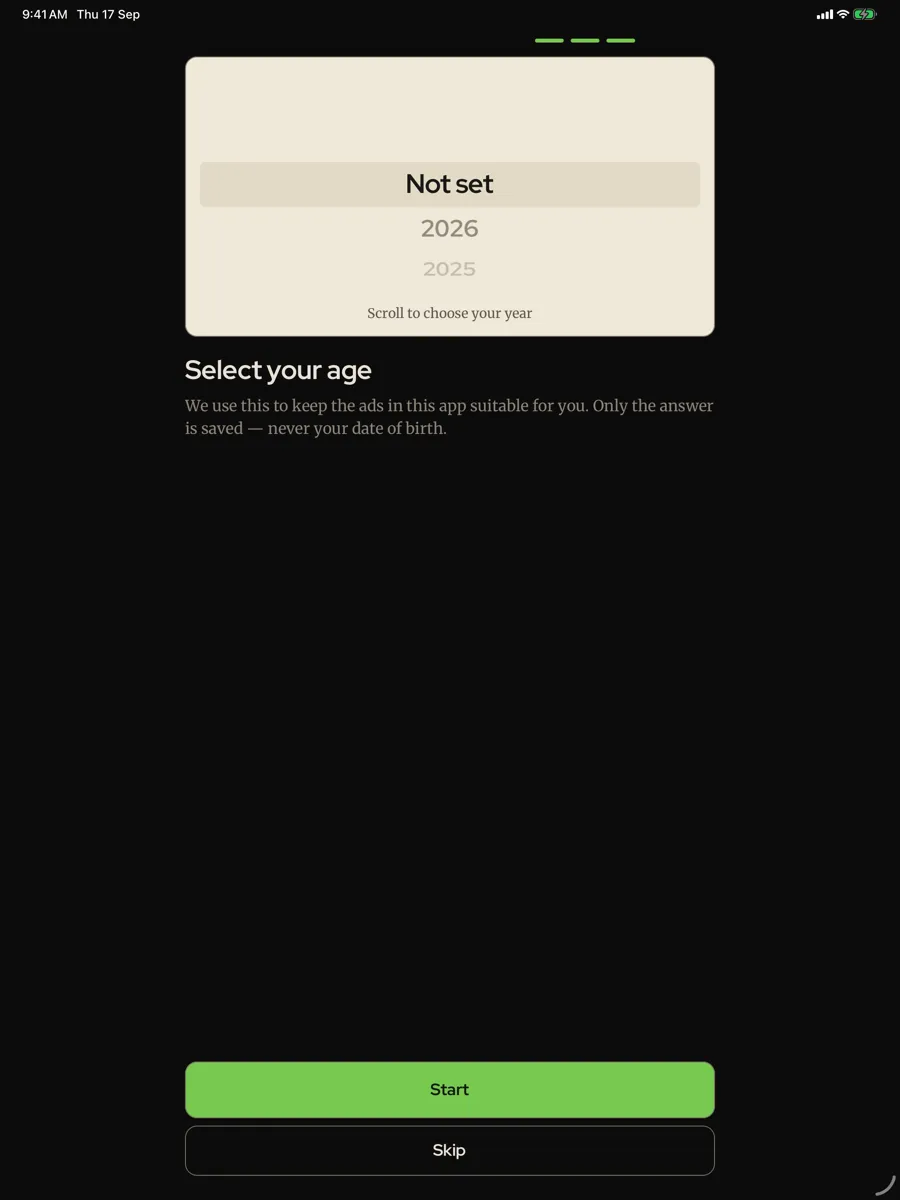
The free tier carries ads from Google AdMob, which is the one thing that sends anything off your device. What that involves is set out plainly in the privacy policy.


D'autres apps comme Subledger
-

Aubade: Daily Affirmations
Une phrase par jour, sur le papier et sur votre écran d'accueil.
-

Valise: Trip Planner & Split
Le plan, la carte et l'argent d'un voyage, dans une valise sur votre téléphone.
-

Quadrille: QR Scanner & Maker
Des codes QR comme objets de design : stylez-les, scannez-les, gardez-les.
-

Paid in Full: Debt Free Date
Voyez votre date sans dettes, ce que coûtent intérêts et frais, et suivez chaque paiement.