
Payoff
Saisissez vos dettes. Voyez la date de votre libération.
- IOS
- ANDROID
- Utilitaire
- Bientôt disponible
À propos de Payoff
Saisissez vos dettes — solde, taux, mensualité minimale — et Payoff répond par une seule chose : le mois où vous serez libre de dettes. Ensuite, déplacez-le. Un curseur de versement supplémentaire recalcule tout l’échéancier en direct et affiche les mois gagnés et les intérêts évités. Comparez boule de neige et avalanche côte à côte, avec le compromis énoncé plutôt que masqué. Consignez ce que vous avez réellement payé. L’argent est stocké en centimes entiers, tout reste sur votre appareil, et si un plan ne peut jamais aboutir, l’application le dit.
Fonctionnalités
One Date, and It Moves
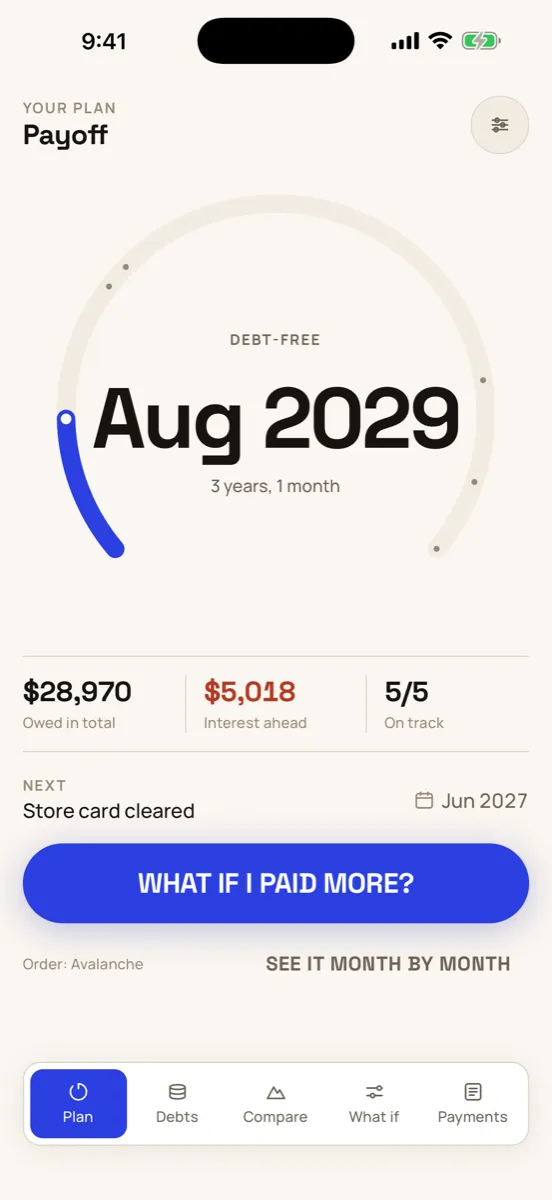
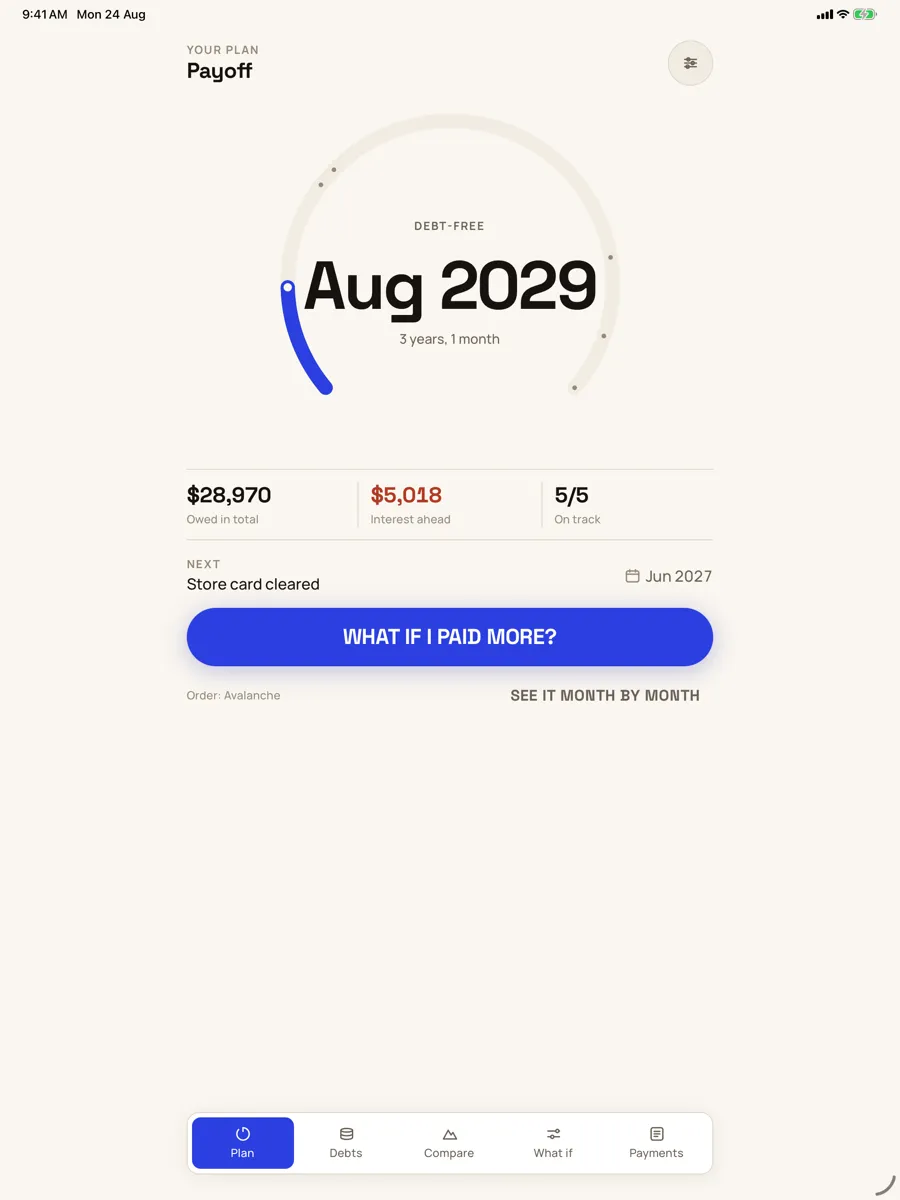
The home screen answers with a single month, drawn as large as the app can manage, inside a progress ring whose ticks are your individual debts disappearing. Everything else in the app exists to make that date trustworthy
The What-If Simulator
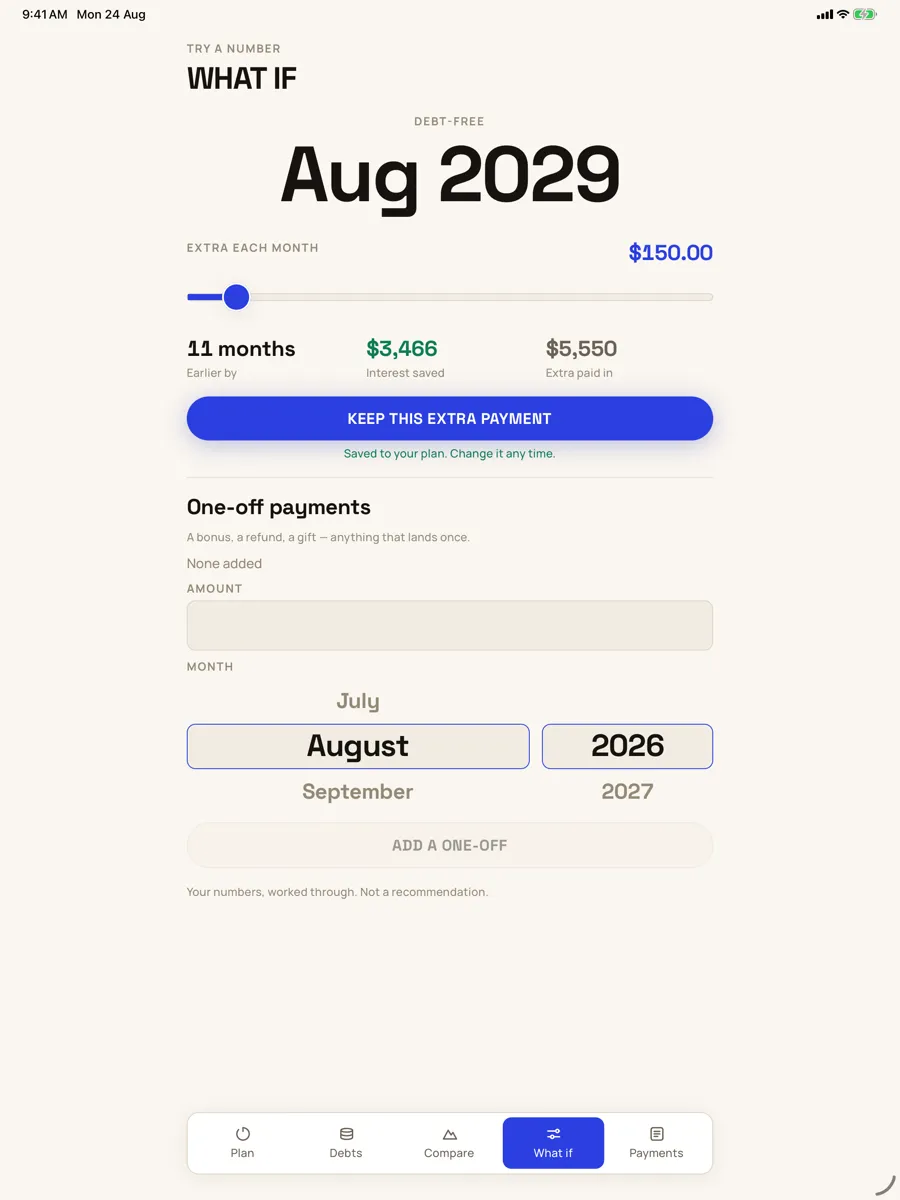
Drag a slider for an extra monthly payment and the whole schedule recomputes on every frame: the payoff date pulls closer, the months saved count up, the total interest falls. One-off lump sums can be placed in any future month
Snowball, Avalanche or Your Own Order
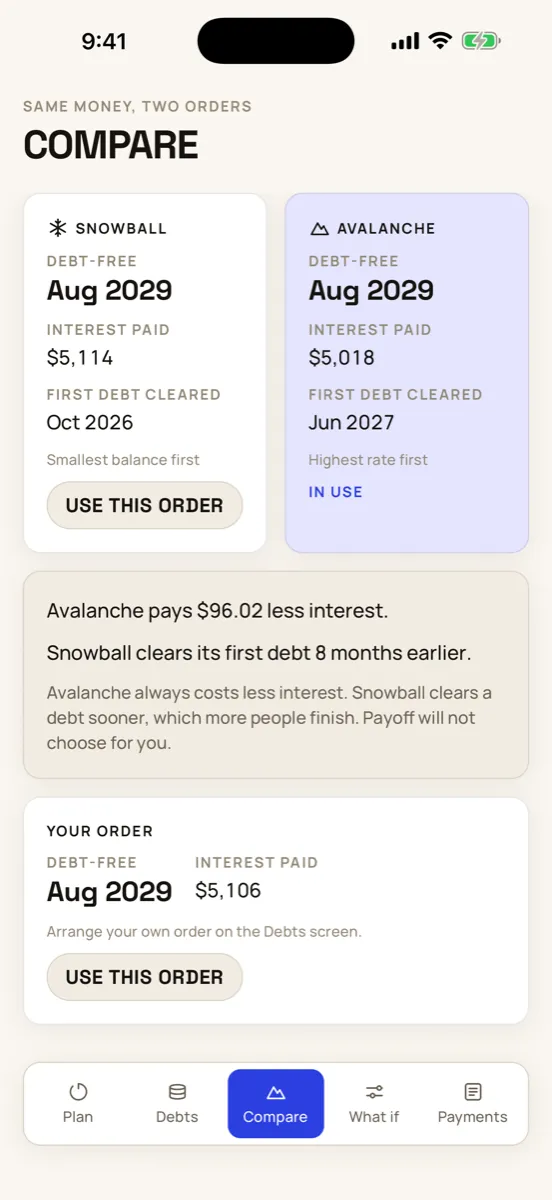
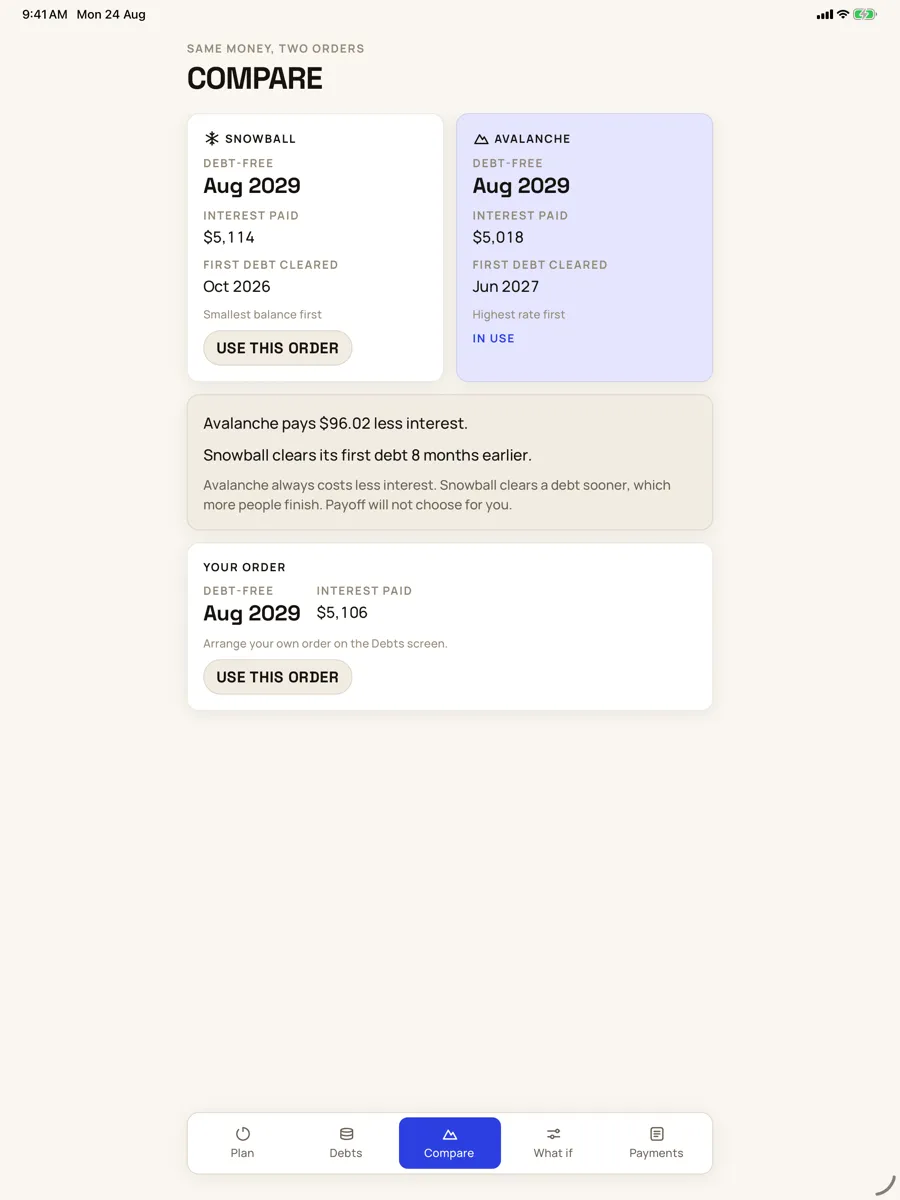
Smallest balance first against highest rate first, side by side, with the trade-off stated rather than hidden: avalanche usually costs less interest, snowball clears a debt sooner. The app does not choose for you, and a custom order lets you put a family loan wherever you want it
It Reports a Plan That Cannot Work
If a month's payments do not exceed that month's interest and no future lump sum rescues it, the balance grows and nothing ever clears. Payoff says so and names the debts that are growing, instead of drawing a comforting curve toward a date ninety years out
Money as Whole Cents, Not Floats
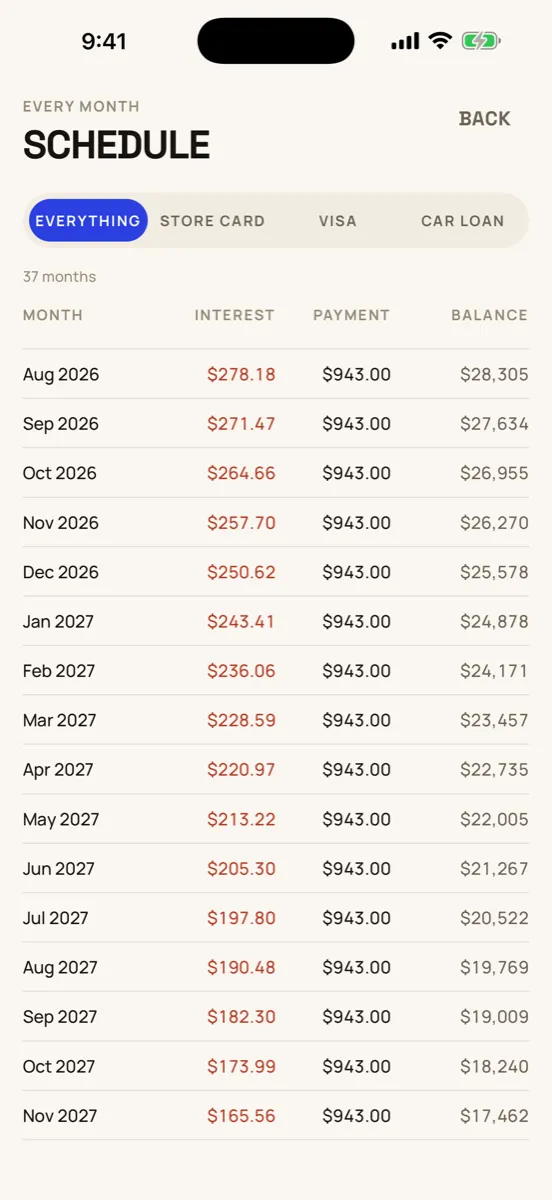
Every amount is an integer number of minor units — cents, pence, yen — with one rounding rule stated once and applied once per month: half-up on exact integers, the way a statement does it. Tests assert that money paid in equals principal plus interest, to the cent
Plan Versus Actual, and a Way Out
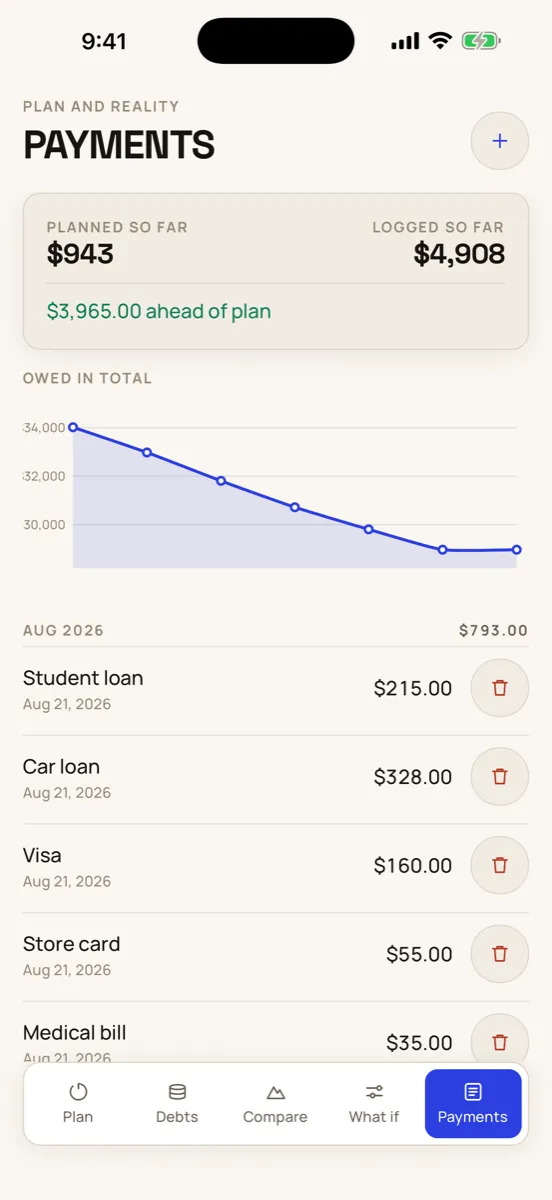
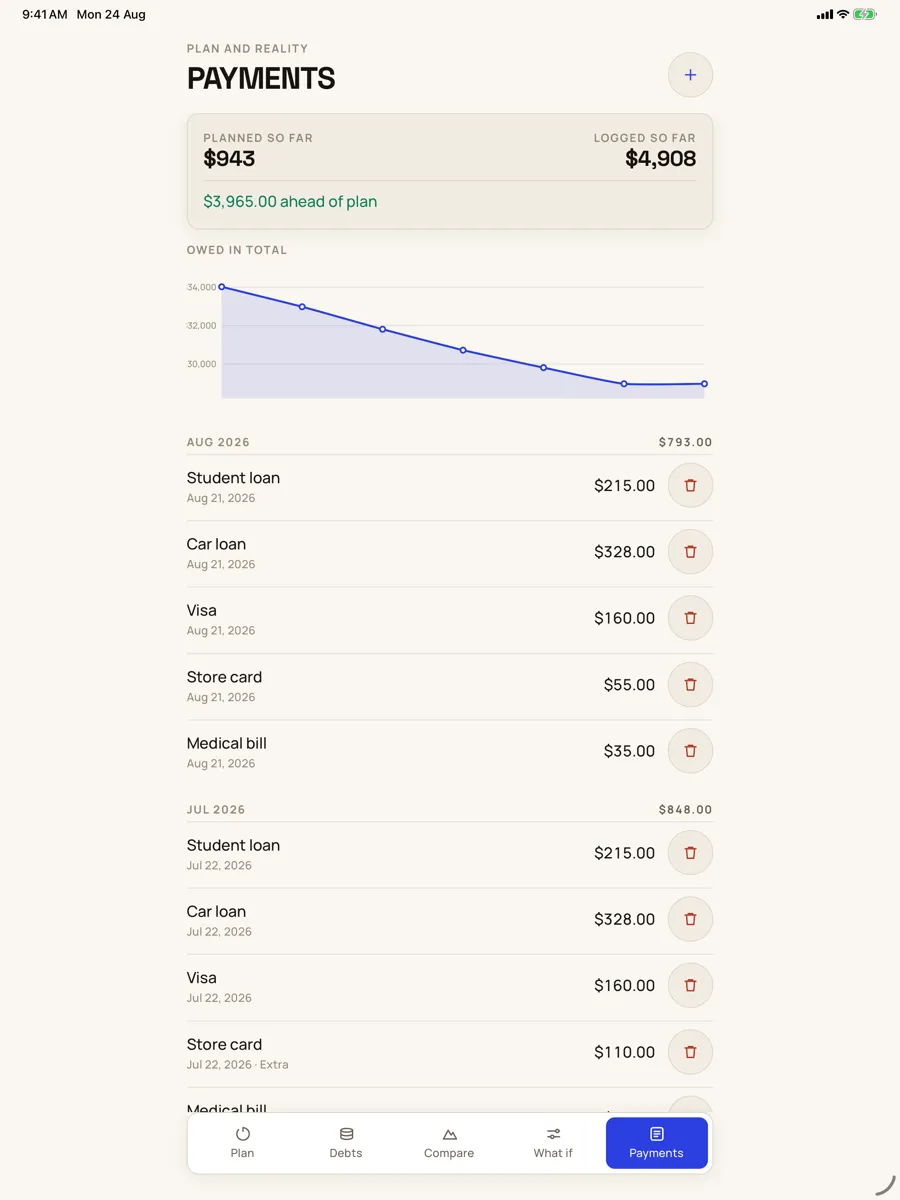
Log what you really paid and see a signed number — ahead or behind — with no streaks, grades or scolding. Debts, payments and daily snapshots live in SQLite on your device, and CSV export hands the schedule, the debts and the log to your share sheet
Captures d'écran


Le descriptif détaillé ci-dessous n'est pas encore traduit et s'affiche en anglais.
About Payoff
Most debt apps answer a question nobody asked: how much do you owe? You already know that — it is the number you avoid looking at. Payoff answers the one you actually want answered, when does this end?, and then lets you push that date around.
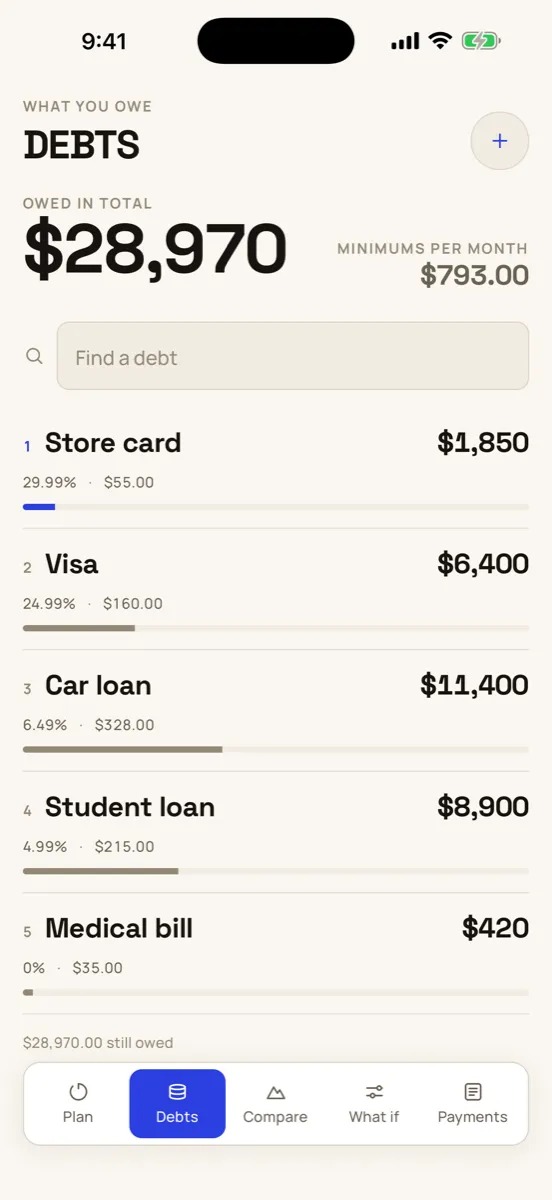
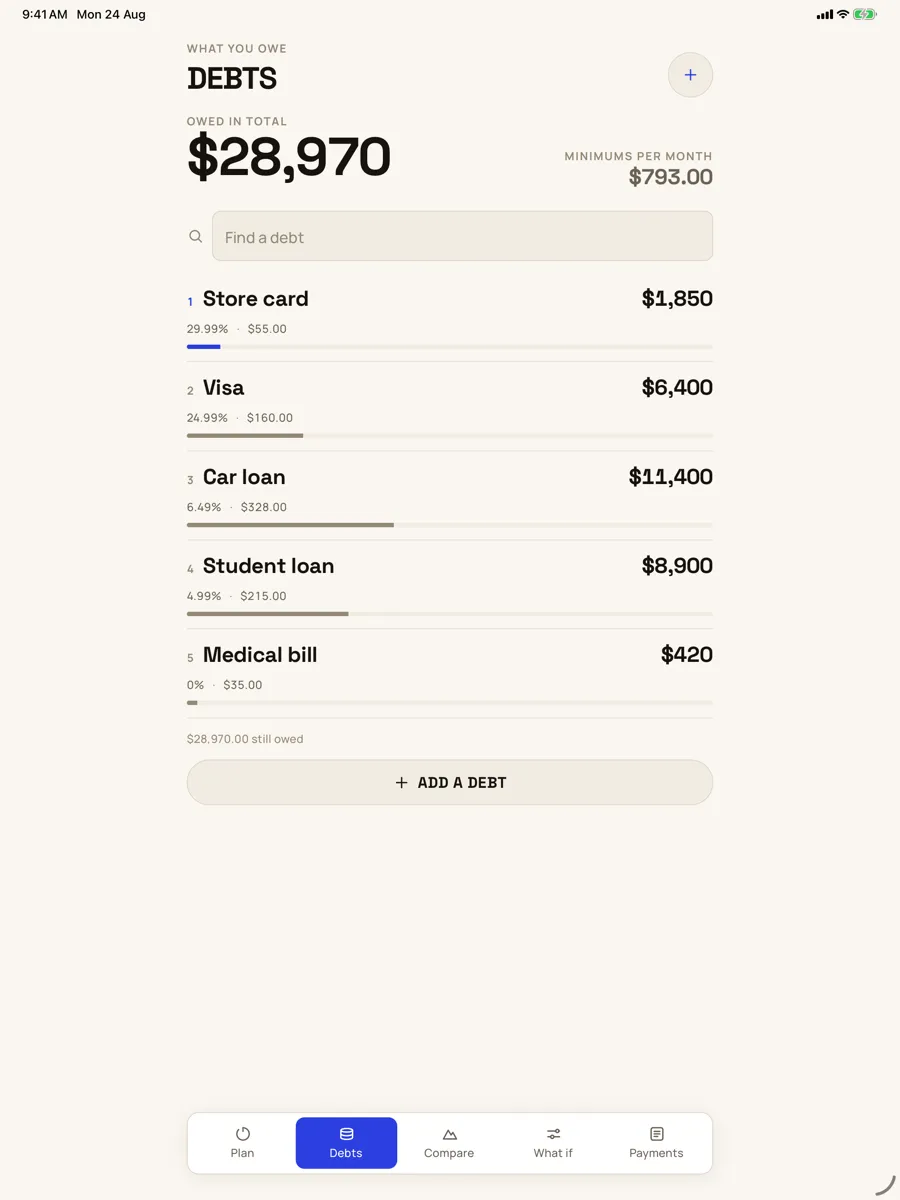
Enter each debt: name, balance, interest rate, minimum payment, currency, and a promotional rate if one applies. The home screen replies with a single month, at the largest size the app can draw, inside a ring whose ticks are your individual debts disappearing one at a time.
Why the simulator is the whole app
The date on its own is information. The date moving is the product.
Drag the extra-payment slider and the entire schedule recomputes on every frame: the payoff date pulls closer, the months saved count up, the total interest falls. Drop a one-off lump sum into a future month — a bonus, a tax refund — and see exactly what it buys.
There is no better argument for skipping something than watching what skipping it is worth, in months. Not “you shouldn’t”, but “that is eleven weeks”. You may still decide it is worth it; at least you decided knowing the price.
Snowball, avalanche, and why the app refuses to choose
Snowball clears the smallest balance first, so a whole debt disappears sooner. Avalanche attacks the highest rate first, and is arithmetically the cheapest ordering of a fixed monthly pool — always. Payoff shows both side by side and states the trade-off out loud instead of burying it: avalanche usually costs less money, snowball is more often finished.
The app does not pick one for you, and that is deliberate. You know things about yourself that a payment schedule does not — whether an early win is what keeps you going, or whether one of these debts is a loan from a family member you want gone for reasons that are not arithmetic. So there is a third option: drag them into whatever order you like. There is no “recommended” badge anywhere in the app, and the code carries a comment saying there must never be one.
The screen we did not soften
If a minimum payment does not cover a month’s interest, the balance grows and no schedule ever finishes. That is not an exotic input; it is an ordinary credit card in a bad year.
Payoff reports it. It says the plan never pays off and names the debts that are growing, rather than grinding out a comforting date ninety years away or drawing a curve that gently approaches zero. It is an unpleasant screen and a true one — and finding out from an app in ten seconds beats finding out from four years of statements.
Arithmetic you can check
Every amount is a whole number of minor units: cents, pence, yen. There are no floating-point numbers anywhere in the money path, because a schedule multiplies and adds hundreds of times, and “wrong in the last cent” is how a money app loses you for good. The rounding rule is stated once and tested: half-up, once per month, on exact integers — what a statement does.
The engine’s other choices are opinions, and the code says so rather than pretending otherwise: a simple monthly rate of APR ÷ 12 rather than daily compounding, interest rounded monthly, a payment order fixed for the whole plan. Each is defensible, and each will differ slightly from some lender’s arithmetic. This schedule is a model. Your lender’s statement is the authority.
What it is not
Payoff computes arithmetic on numbers you typed in. It is not financial advice: it never recommends consolidating, refinancing, or which debt to attack — it presents the comparison and you choose. And it has no bank connection of any kind: no linking, no imports, no credentials, and no technical ability to acquire any.
Real life does not follow a schedule either, so you can log what you actually paid. The app shows a signed number — ahead of plan, or behind — with no streaks, no grades and no scolding. Being behind is the normal case, and an app that treats it as failure gets deleted in exactly the month you needed it.
Free, and then one payment
Free is a whole working app: two debts, the snowball order, the real date, the months just ahead of you, and the payment log. One purchase unlocks unlimited debts, avalanche and custom ordering, the simulator, the full schedule and CSV export — and removes the ads. It is a single payment, not a subscription. Charging rent to somebody who is trying to stop paying interest would be a strange way to earn a living.
Privacy, plainly
- No account, no server, no bank connection. Your debts are in a database on your phone. We do not have a copy and have no way to get one.
- No analytics, no crash reporting. We cannot see how you use the app — there is nowhere for that data to go.
- Ads, disclosed. The free tier carries Google AdMob ads on the debt list and the settings screen. Consent is requested where the law requires it, ad content is capped below the adult categories regardless, and there are never ads over the schedule or the simulator.
- Get your data out. CSV export of the schedule, the debts and the payment log, written on your device and handed to the system share sheet.
Full detail is in the privacy policy.