Subledger: Subscription Log
Alles, was sich verlängert – ohne Bankzugang.
- IOS
- ANDROID
- Werkzeuge
- Verfügbar


Über Subledger
Ein manueller Überblick über alles, was sich verlängert: Abos, Versicherungen, Domains, Mitgliedschaften, Garantien. Die App verbindet sich nie mit einer Bank – du trägst selbst ein, was du zahlst, und aus einem Haufen monatlicher und vierteljährlicher Beträge wird eine einzige ehrliche Jahreszahl, getrennt nach Währung und nie über Währungen hinweg addiert. Hinweise zum Testende warnen dich, bevor eine Gratisphase kostenpflichtig wird. Abbuchungstermine beruhen auf Kalenderarithmetik, die keine Zeitumstellung verschieben kann, und alles bleibt auf deinem Gerät.
Funktionen
Niemals eine Bankverbindung
Du trägst jeden Posten selbst ein. Es gibt kein Konto, keinen Login, keinen Server von uns und keinen Lesezugriff auf irgendein Institut – die App könnte deine Liste nirgendwohin schicken, selbst wenn sie wollte, und deshalb lässt sich das Versprechen überprüfen, statt nur behauptet zu werden
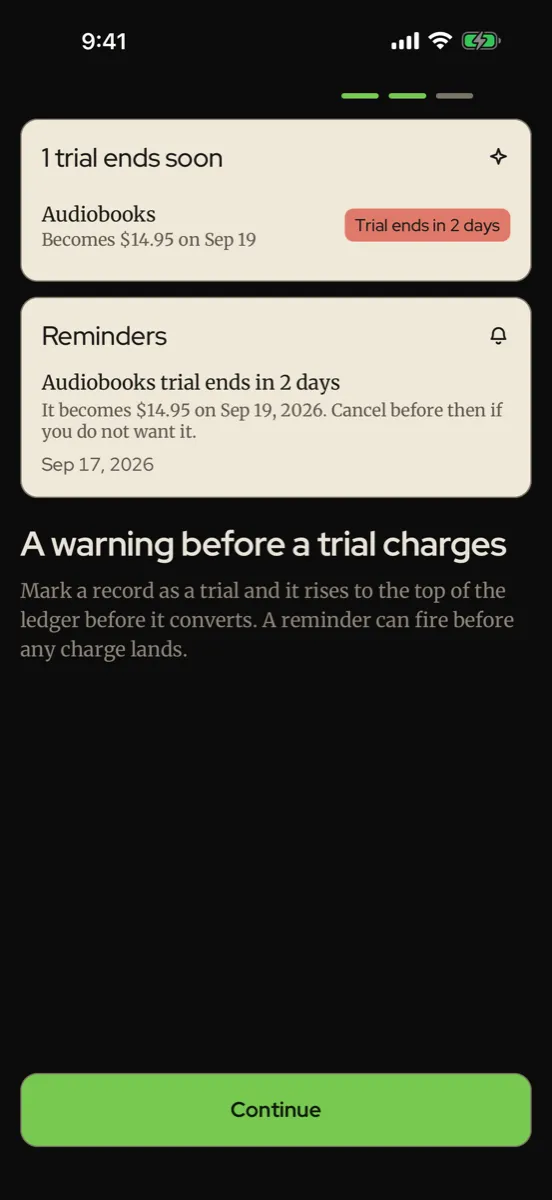
Hinweise zum Testende
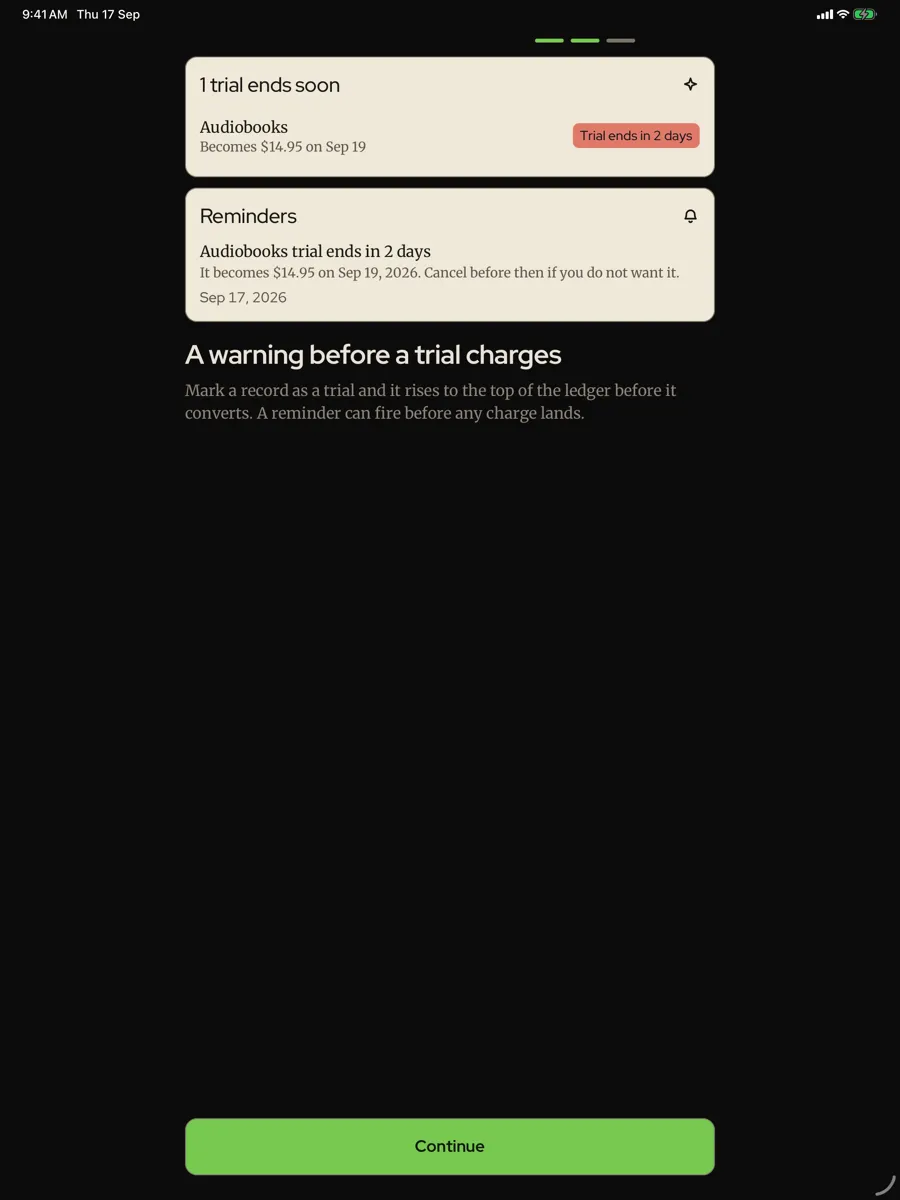
Markiere einen Eintrag als Testphase mit Enddatum, und die App hebt ihn auf dem Startbildschirm hervor und plant standardmäßig zwei Tage vorher eine lokale Benachrichtigung – nicht einen, denn eine Testphase, die morgen kostenpflichtig wird, kann die Kündigungsfrist des Anbieters schon überschritten haben
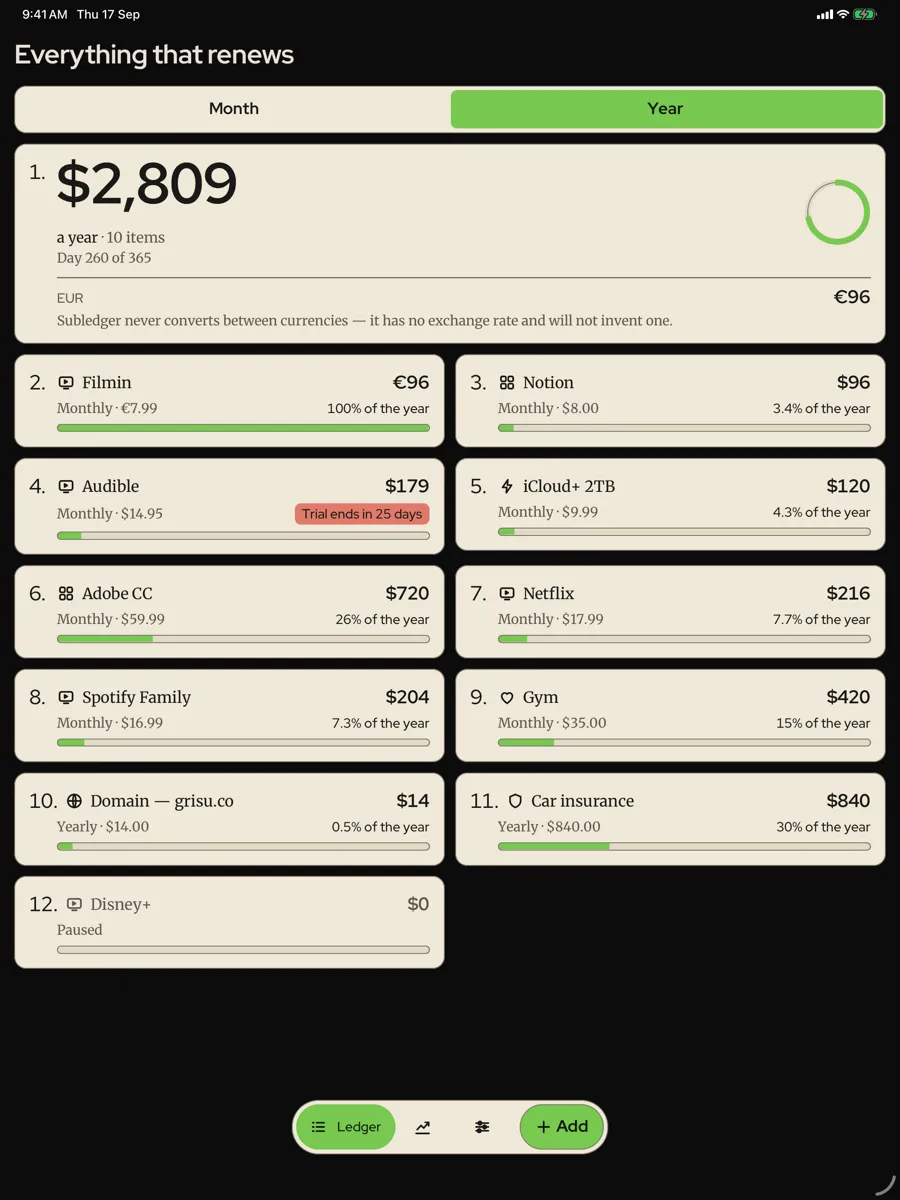
Die ehrliche Jahreszahl
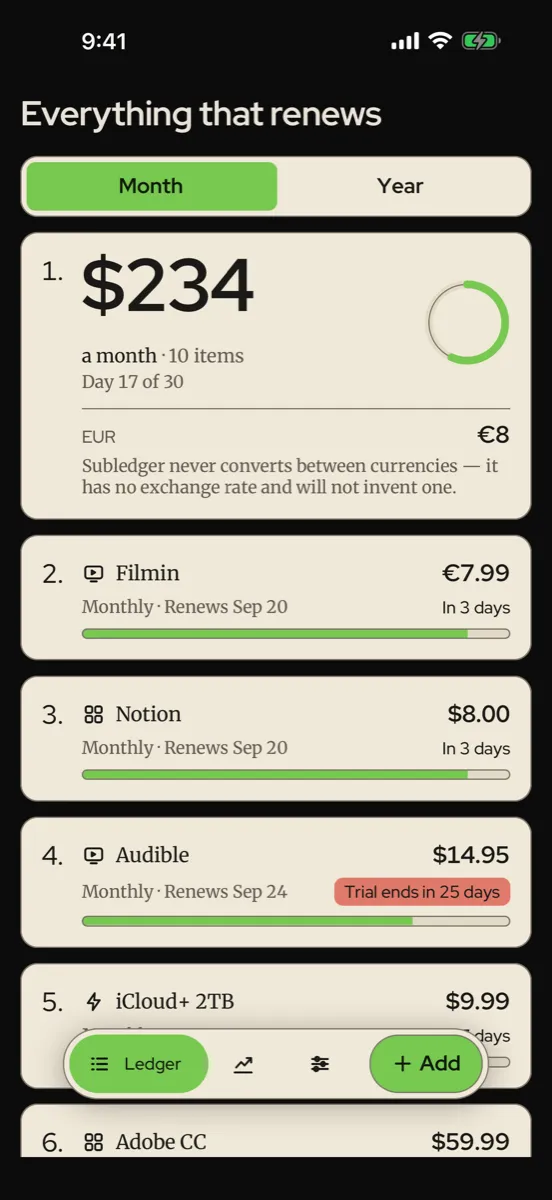
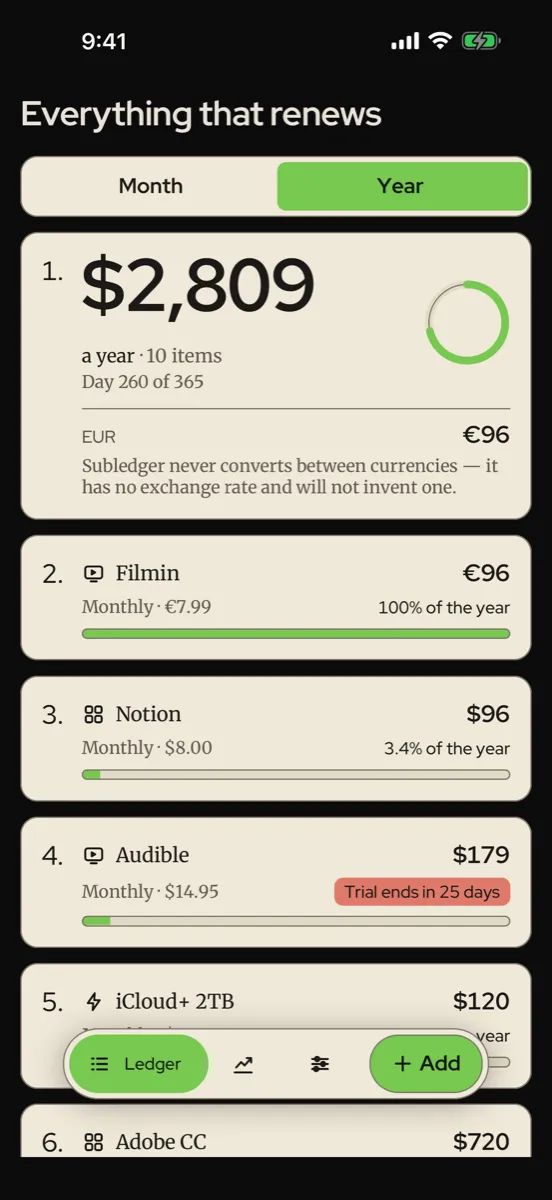
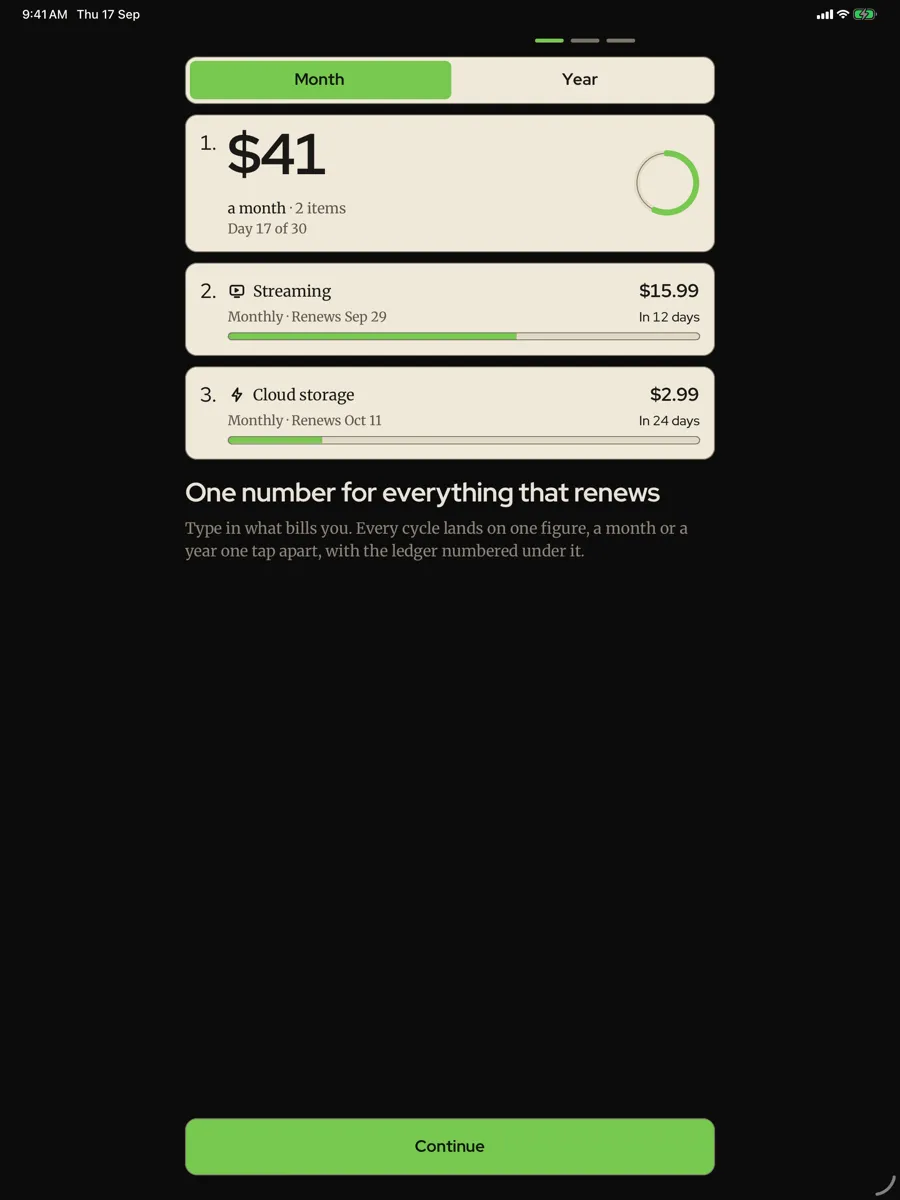
Jeder Zyklus wird auf einen Jahresbetrag umgerechnet, wöchentliche Beträge mit 365,25/7 statt der bequemen 52. Die Zahl wird je Währung angezeigt und nie über Währungen hinweg addiert: Es gibt keinen Offline-Wechselkurs, und eine Summe, die stillschweigend falsch ist, ist schlimmer als gar keine Summe
Abbuchungstermine, die nicht wandern
Termine werden vom ersten Abbuchungsdatum aus gezählt statt vom letzten aus verkettet, also ergibt eine Monatsrechnung, die zuerst am 31. abgebucht wurde, den 28. Februar und dann den 31. März – nicht für immer den 28. März. Gerechnet wird in Kalendertagen, also kann keine Zeitumstellung einen Abbuchungstag verschieben
30-Tage-Zeitleiste und Aufschlüsselung nach Kategorie
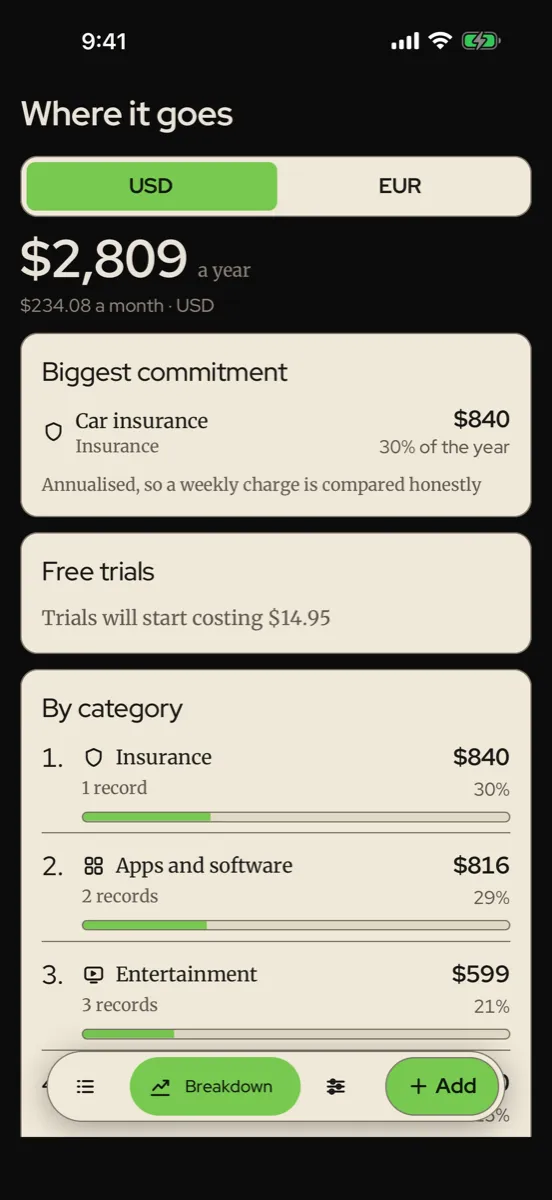
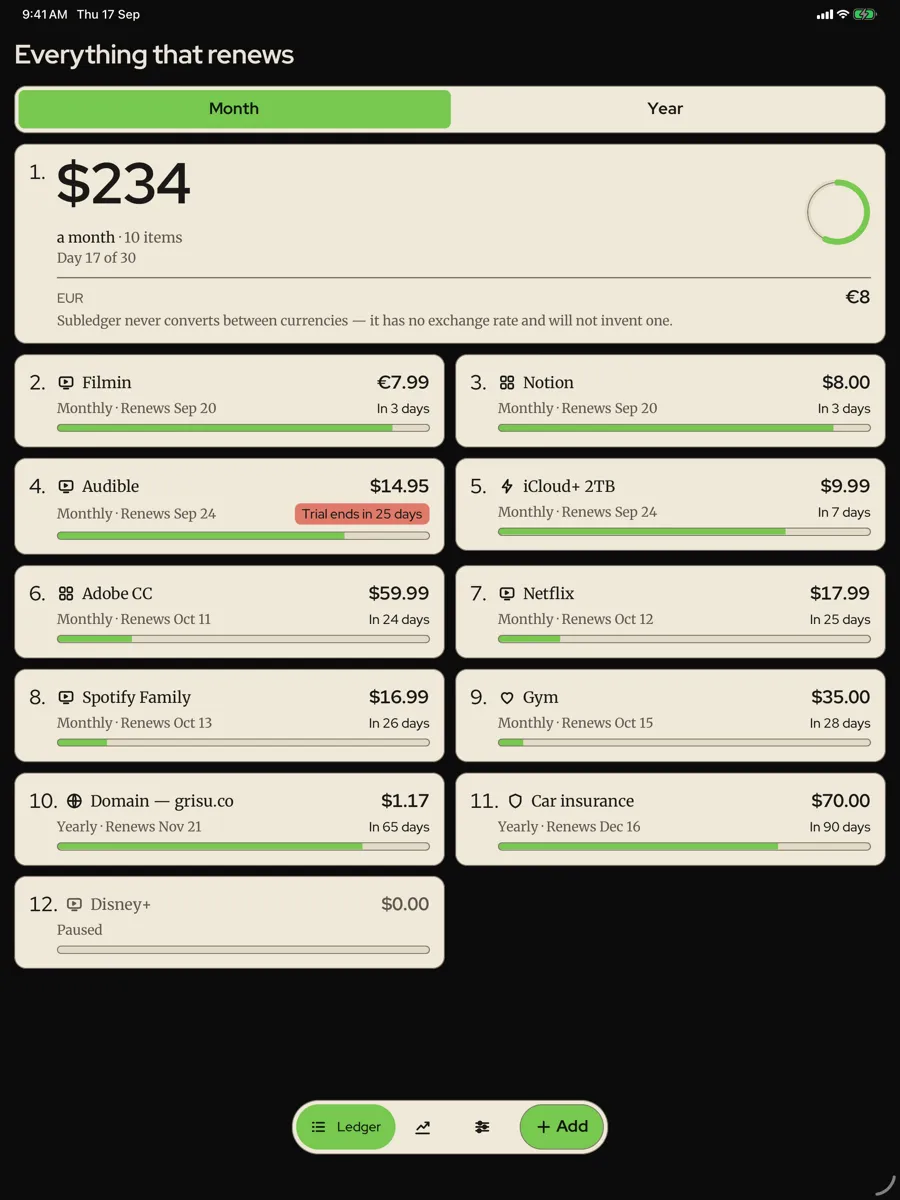
Der Startbildschirm zeigt die Jahreszahl und dann eine datierte Zeitleiste dessen, was in den nächsten dreißig Tagen tatsächlich fällig wird. Die Aufschlüsselung verteilt deine Verpflichtungen auf elf Kategorien – Unterhaltung, Software, Versicherungen, Domains, Garantien und den Rest – ebenfalls je Währung
Einmalzahlung statt Abo
Fünf Einträge sind für immer kostenlos, inklusive Jahreszahl, Zeitleiste und Verlängerungserinnerungen. com.grisu.recur.pro ist ein einmaliger Kauf, der unbegrenzte Einträge, Hinweise zum Testende, die Aufschlüsselung nach Kategorie und den CSV-Export freischaltet – ein Abo-Tracker, der ein Abo verlangt, wäre ein Witz auf deine Kosten
Screenshots
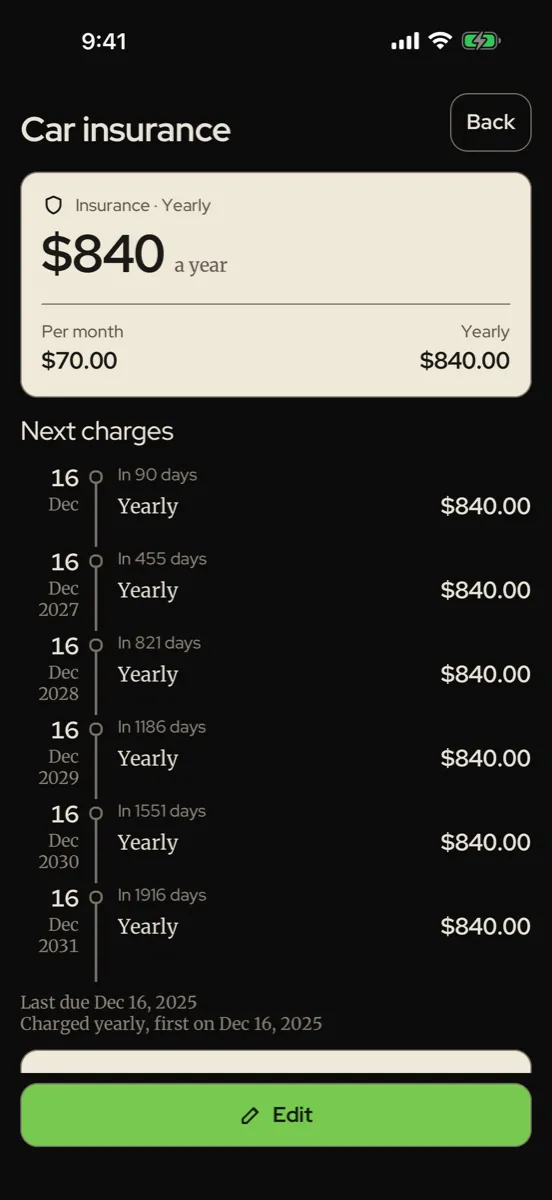
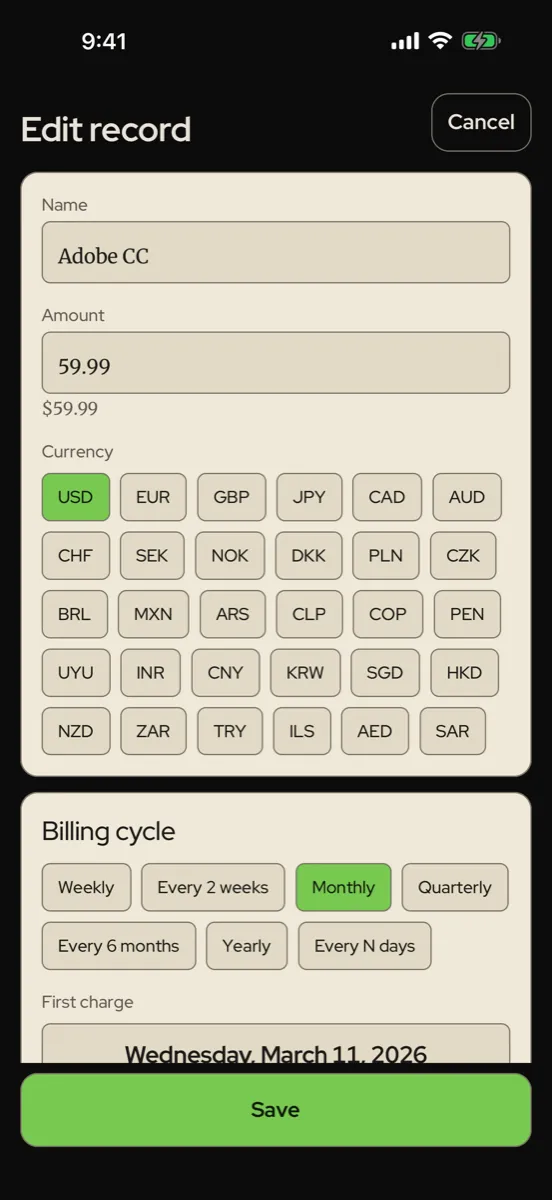
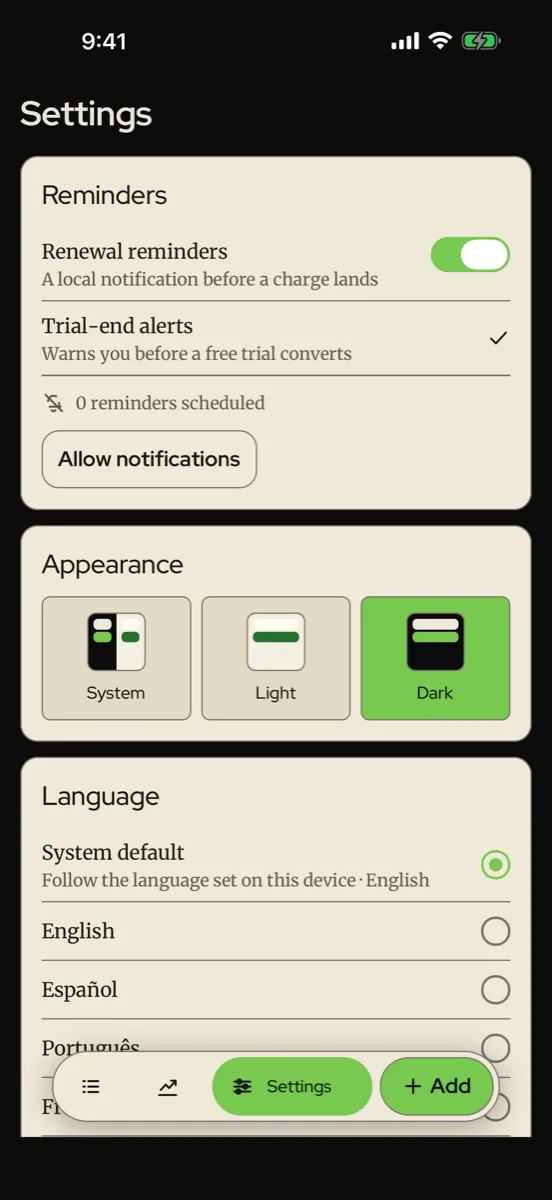
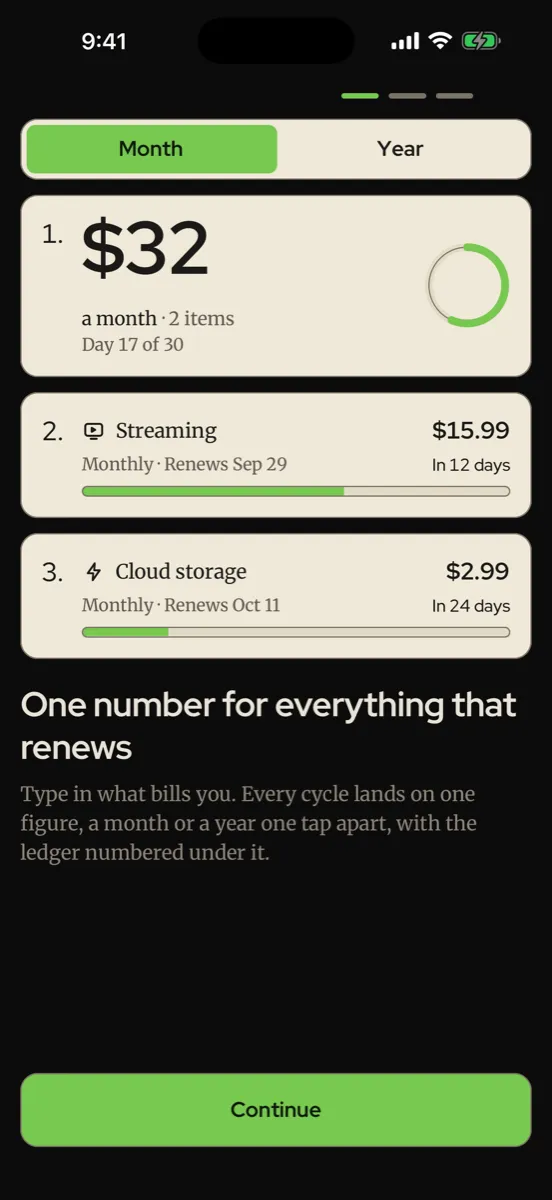
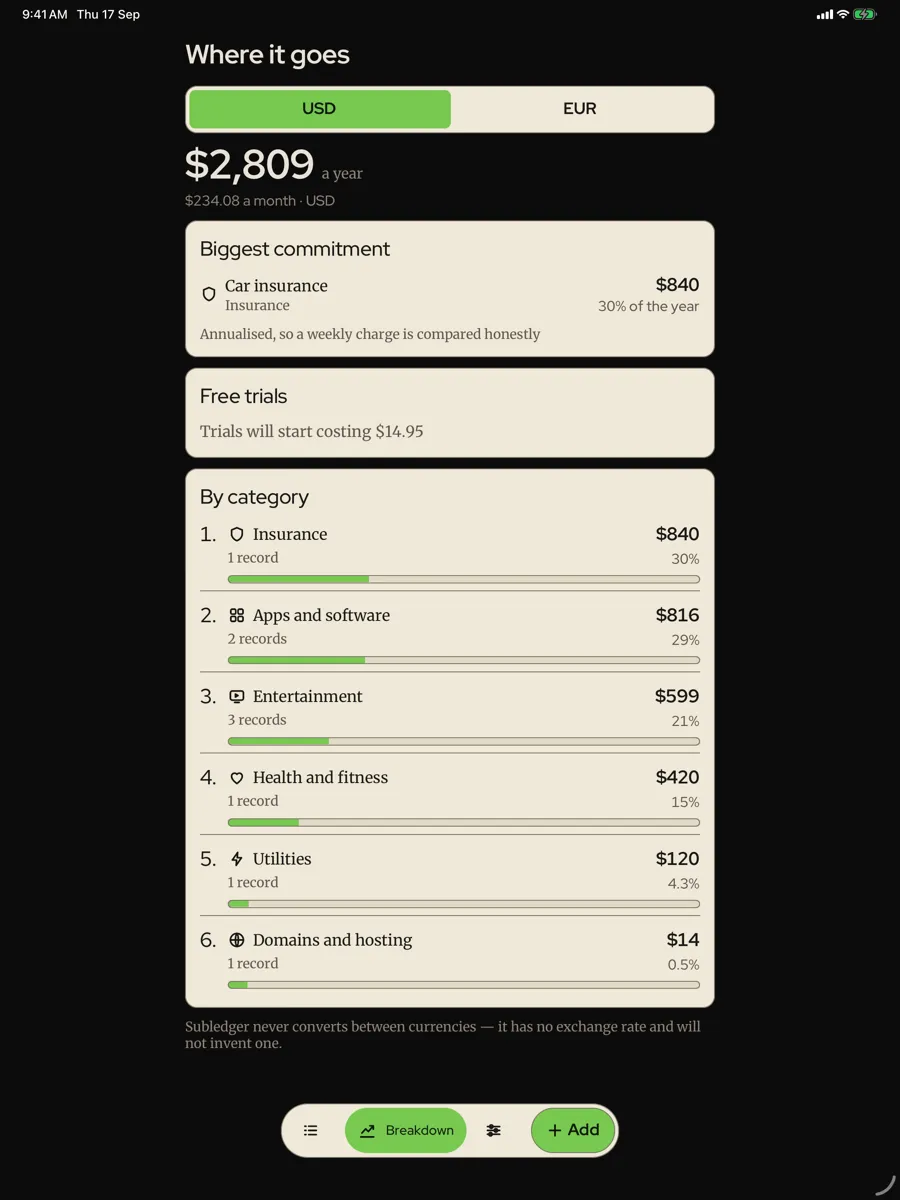
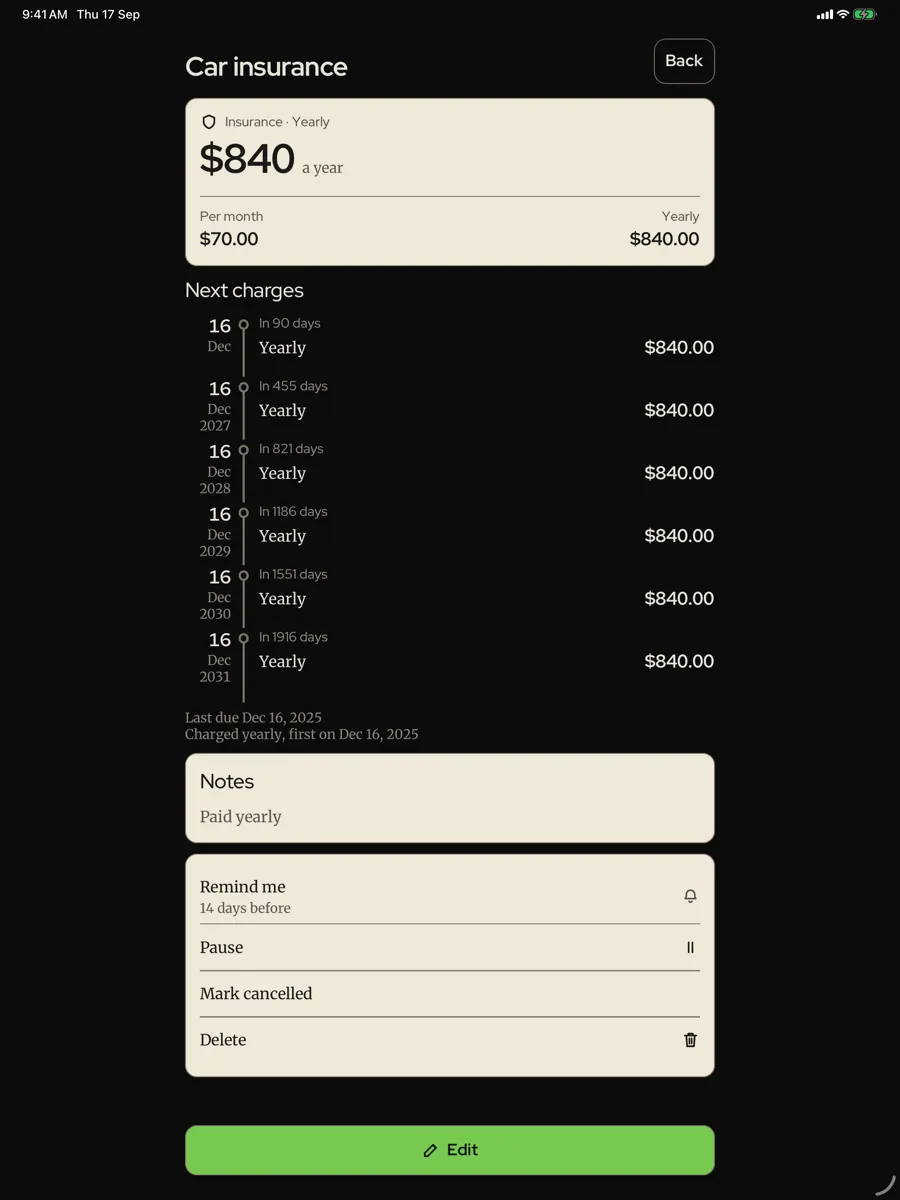
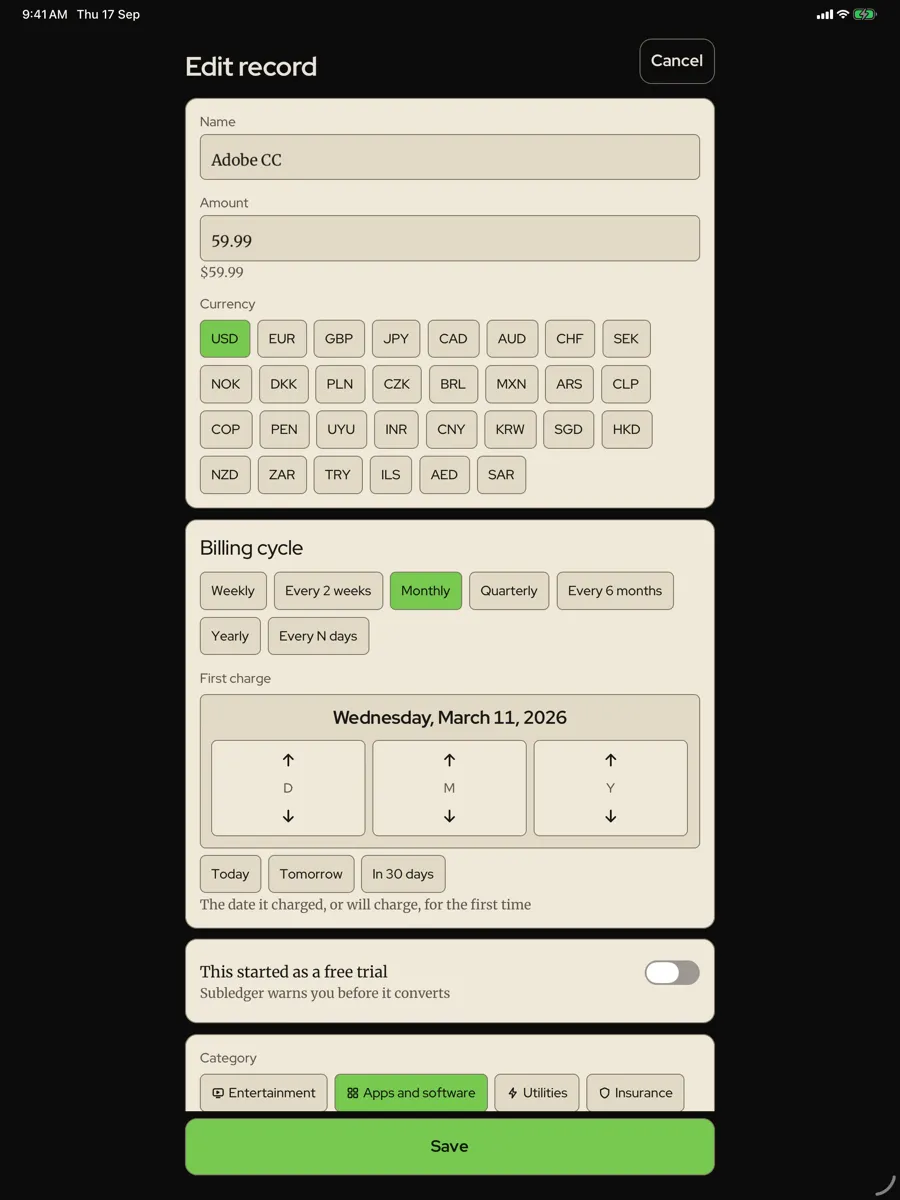
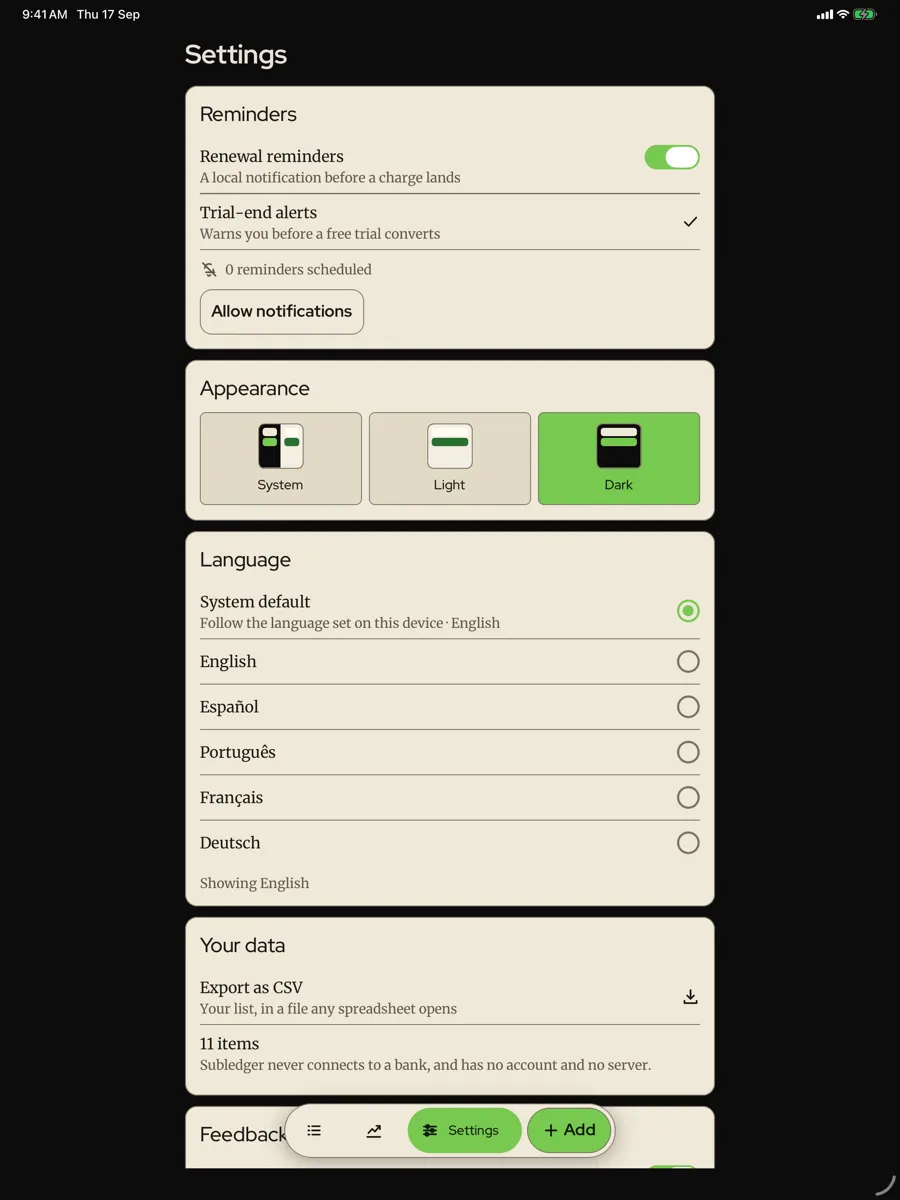
Der ausführliche Text unten ist noch nicht übersetzt und wird auf Englisch angezeigt.
About Subledger
You already know roughly what you pay every month. Subledger exists to replace roughly with a number — and to do it without ever asking for a bank login.
You type each item in: name, amount, currency, cycle, the date it first charged. In return the app gives you the figure that pile of small charges actually adds up to over a year, a dated timeline of what is due in the next thirty days, and a warning before a free trial turns into a charge. Subscriptions, insurance premiums, domain renewals, gym memberships, extended warranties — anything with a next date and a cycle belongs here.
Why it will never connect to your bank
The obvious way to build this app is to read your transactions. The best-known product in the category does exactly that, and charges a monthly fee for the privilege of watching your money move.
Subledger takes the opposite trade deliberately. Typing in a dozen items costs you ten minutes once; handing a third party a live feed of every purchase you make costs you something you cannot get back. So there is no aggregator, no OAuth screen, no read-only credential, no account and no server of ours. Your list lives in a SQLite database inside the app’s private storage, and the only thing that ever leaves the device is a CSV file you explicitly asked to export and then chose where to send.
That is not a feature we can quietly drop in a later version. There is nothing to switch on: the app was written without the network path in the first place.
The number, and why it refuses to lie to you
A list of “$4.99 a month”, “£12 a quarter” and “€89 a year” is not readable as a commitment. Normalising all of it to one per-year figure is the single transformation that makes the total something you can react to, and it is the largest thing on the home screen.
Two decisions keep that number honest. Weekly charges are annualised at 365.25 ÷ 7, not 52 — a weekly bill charges 52.18 times a year, and the comfortable answer under-reports exactly the cycles people already underestimate. And nothing is ever summed across currencies. The app has no exchange rate, because it has no network to get one from, and a rate baked in at build time would be wrong within a week. So dollars, euros and pounds are reported side by side, per currency, and the code will throw rather than produce a plausible-looking total that mixes them.
Dates computed the boring way
The arithmetic underneath uses no timestamp at all. A billing date here is a civil calendar date — a year, a month and a day, with no time and no zone — and every calculation is exact integer maths over a day count. A daylight-saving transition has nothing to shift.
Occurrences are also indexed from the anchor rather than chained from the previous one, which is what stops the classic drift: a monthly bill first charged on 31 January falls on 28 February and then back on 31 March, instead of quietly moving to the 28th for the rest of its life. The same logic drives the timeline, the annualised cost and the reminder schedule.
Currency symbols, decimal places and date formats come from your device rather than from a hardcoded assumption, so an amount typed as 1.234,56 and one typed as 1,234.56 reach the same number.
What it costs
Five tracked items are free, permanently — enough to see the number the app exists to show. One payment unlocks unlimited items, the trial-end alerts, the category breakdown and CSV export. Not a subscription: for this app in particular, that matters.
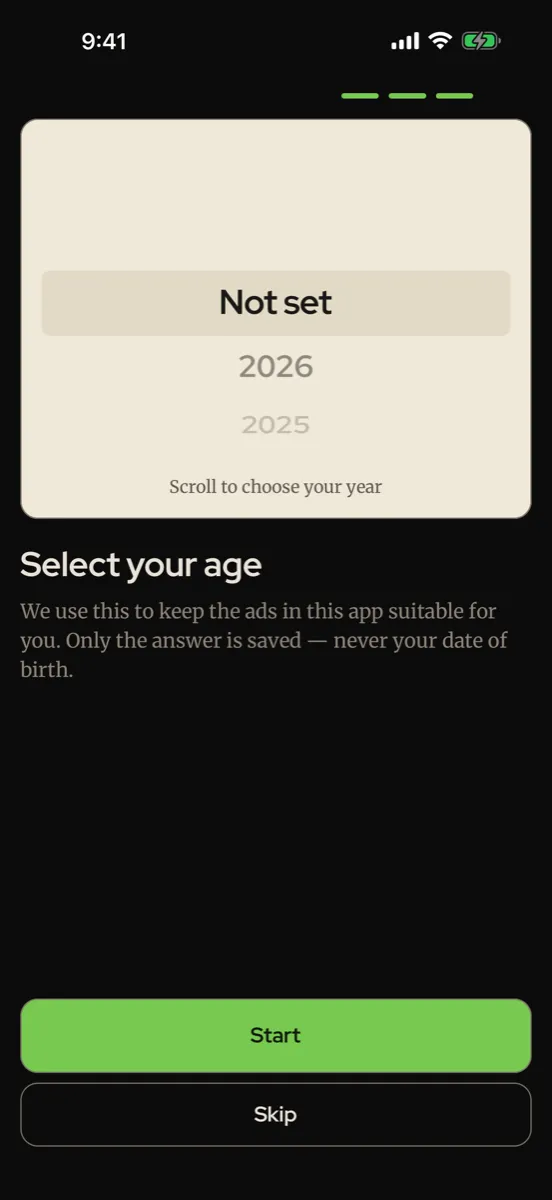
The free tier carries ads from Google AdMob, which is the one thing that sends anything off your device. What that involves is set out plainly in the privacy policy.


Weitere Apps wie Subledger
-

Aubade: Daily Affirmations
Ein Satz am Tag, auf Papier und auf deinem Homescreen.
-

Valise: Trip Planner & Split
Plan, Karte und Geld einer Reise – in einem Koffer auf deinem Telefon.
-

Quadrille: QR Scanner & Maker
QR-Codes als Designobjekte: gestalten, scannen, aufbewahren.
-

Paid in Full: Debt Free Date
Sieh dein Schuldenfrei-Datum, was Zinsen und Gebühren kosten, und verfolge jede Zahlung.